


How Can We Make Studies Fun for Class 2 Kids?
You sit down to study with your class 2 child; after 10 minutes, they begin to fidget, stare at the wall or ask for a break. Sounds familiar? Kids in class 2 have very short attention spans, and long sessions lose them quickly. They learn best when they move, touch and play, not when they sit and listen.
This is why activity-based learning suits 7-8 years old best. The child who plays with and counts blocks remembers numbers better than the child who copies numbers off a board. A child who acts out a story knows it better than one who reads it silently.
In this blog, we’ll learn how to make lessons interactive and curious for kids. Also, how not to overhaul the kids’ schedule.
Why Making Study Fun for Class 2 Kids is Necessary?
It makes kids curious. The child who loves a subject asks more questions and wants to learn more. That curiosity extends to all subjects, not just the one they enjoyed that day.
It helps kids understand difficult concepts more easily. Abstract ideas (like addition or grammar rules) are easier to understand when kids see them in a game or story, not in a printed page.
It helps with retention. Kids remember their experiences. A definition once learned by heart will not be retained as long as a rhyme, a game or a practical activity.
It reduces resistance to homework. When study time feels like play, it is no longer a chore for children. That one change alone would remove half of the daily struggle of parenting.
10 Fun Ways to Make Study Interesting for Class 2 Kids
1. Turn Lessons Into Small Games
Games give children a reason to try, not a task to do.
-
Quiz games: Ask fast questions in between chapters. If your kid likes competition, keep score.
-
Flashcards: Good for spellings, tables or new words. Check a few out every day.
-
Matching games: Match words with pictures or states with their capitals for visual learning.
-
Word games: Build vocabulary with word chains, fill-in-the-blank and other effortless games.
2. Tell Stories to Explain Concepts
A story gives context to a concept, and context makes it sticky.
-
Maths in everyday stories: Make a "apple subtraction" story about sharing fruit with a friend.
-
EVS thru real life situations: Talk about why leaves fall or where the water goes when it rains using things your child has actually seen.
-
English with story telling: Read a short story and ask your child to tell the story in his own words.
3. Combine Learning with Daily Activities
The best lessons aren’t always at the study table.
-
Counting while shopping: Have your child count items in the cart or check change while shopping.
-
Measuring during cooking: Allowing them to measure flour or water for a recipe.
-
Read signs and labels: When walking or driving, show shop names, road signs and labels.
-
Identify plants, animals and objects: Turn a park visit into a spotting game.
4. Use Drawing & Colouring in Learning
This age group is a good fit for visual learning.
-
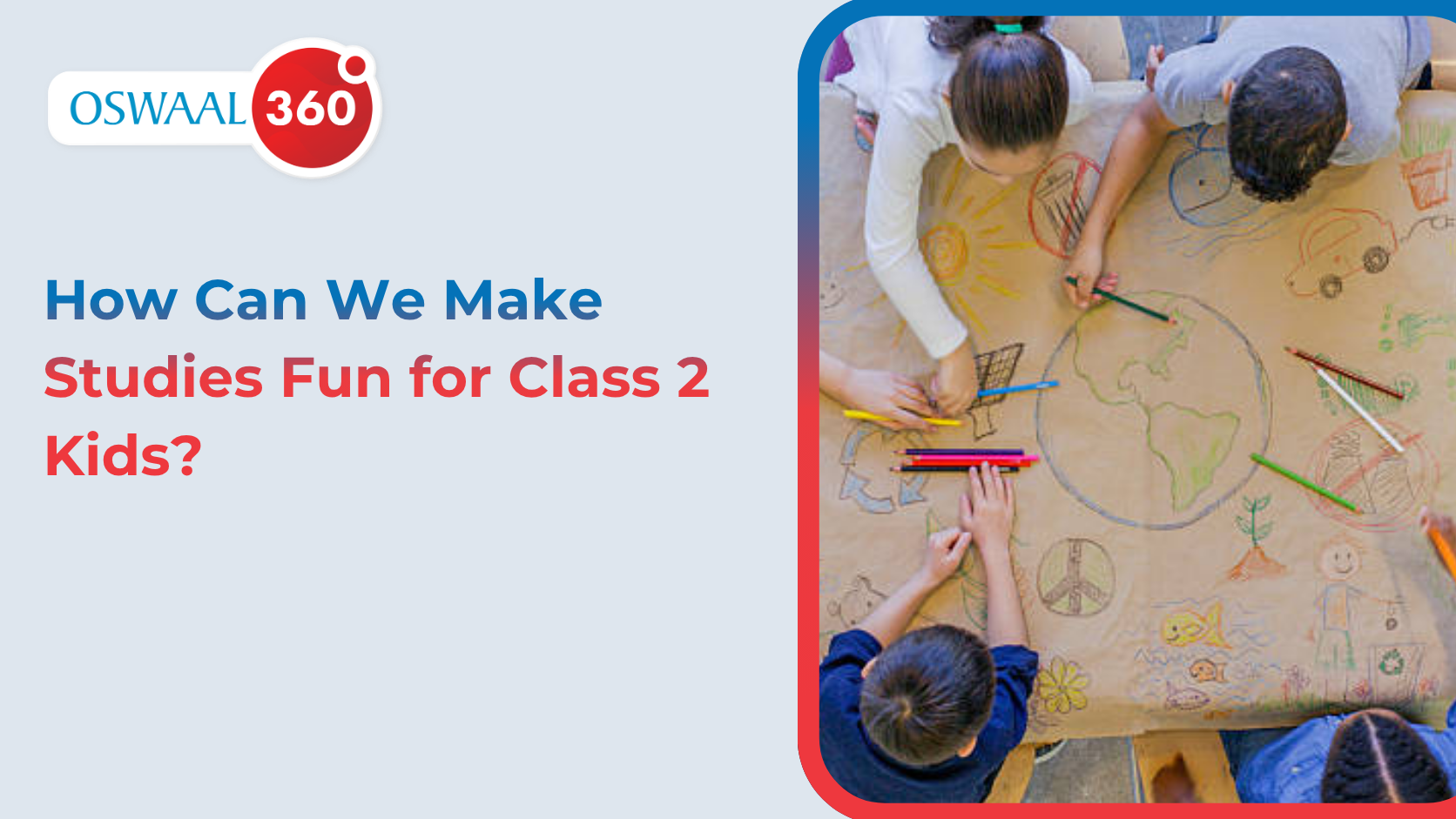
Draw what they learn: Ask your child draw a scene from a story or a science concept.
-
Make simple mind maps: Link ideas on a subject with circles and arrows.
-
Colour-based learning activities: Use colour maps, diagrams or number charts to make revision visual.
5. Practice with a Class 2 Workbook
A good workbook gives you the structure to practise without it feeling like more work.
-
Short practices: 10-15 minutes a day works better than one long practice.
-
Activity-based questions: Go for workbooks that include puzzles, fill-ups and pictures, rather than only written answers.
-
Revision without pressure on kids: Workbook can be used for revising what is already taught in school, not for adding on new pressure.
-
Make workbook practice relevant to school lessons: Relate workbook chapters to what your child is learning in school.
6. Connect With Readers
Reading time is best as a conversation, not a monologue.
-
Read stories together: Read turn by turn.
-
Ask “what happens next?”: Stop in the middle of a story and have your child guess what happens next.
-
Let the children tell the story: Ask them to tell you in their own words what they have read.
-
CBSE Class 2 Books for Structured Reading and Practice: When a book is aligned with the school syllabus, reading practice becomes relevant to what your child needs to know.
7. Create Mini Challenges
Small challenges provide kids with a visual sense of achievement.
-
5 question challenges: Come up with a quick five question round on any subject.
-
Spelling difficulties: Choose five words and hold a mini spelling bee.
-
Mental maths races: Time your child on easy addition or subtraction.
-
“Beat your best score” Activities: Keep track of scores over days so your child can see their own progress.
8. Move Learning from Study Table
A change of setting often brings a change of attitude.
-
Walks in nature: Talk about trees, bugs, and the weather while you walk.
-
Count things outside: Count cars, birds or houses on the way.
-
Observation games: Ask your child to find five red things, or five that are round.
-
Learning by the environment: Use the environment around you as the lesson plan of the day.
9. Offer Limited Choices to Children
A little ownership of their own study time.
-
Decide which subject to begin with: Let your child decide the order.
-
Choose an activity: Put it to them. Give them the choice.
-
Choose between writing, drawing, or solving: Children express what they know in different ways.
10. Appreciate the Effort, Not Just the Marks
What gets celebrated gets repeated.
-
Stickers: This age group responds well to small immediate rewards.
-
Progress charts: Visual chart shows growth over weeks vs just one test.
-
Verbal praise: A simple “you worked hard on that” goes a long way more than you think.
-
Small non-material rewards: Extra playtime or favourite activity are better than gifts.
How to make NCERT Workbook for Class 2 not Boring for Parents?
Keep sessions brief. 15 minutes of focused work is better than an hour of distracted effort.
Mix questions and activities. Alternate written answers with drawing / matching / oral questions.
Do not write too many pages at once. If you do a whole chapter in one sitting, you are racing, not learning.
Allow children to do the solving first and on their own. Only get involved after they have tried it themselves.
Talk about mistakes, not just fixing them. Ask your child why they gave that answer, then show them the correct answer.
How long does a child study at home in Class 2?
Make sessions age-appropriate. For most of the children in Class 2, 30 to 45 minutes a day, in two sessions, is adequate.
Keep study segments short. It is better to work ten or fifteen minutes at a time than to try to do it all at once.
Add in movement and play breaks. Children return more focused after a five-minute break between blocks.
Prioritise consistency over long hours. It is better to study in brief, regular sessions than in long, infrequent ones.
Common Parenting Mistakes to Avoid
-
Long study sessions force children into resistance, not focus.
-
Comparing children to each other damages their confidence and puts pressure on them that has nothing to do with learning.
-
When everything is about marks, curiosity turns into anxiety.
-
Giving too much homework on top of what school already assigns doesn’t leave any time for play, which is just as important at this age.
-
Rote learning bypasses understanding, and children soon forget facts they have learnt by rote soon after the test.
Conclusion
Learning doesn’t have to be boring to be educational. Games, stories and outdoor activities still teach the same concepts your child needs to learn for school. The idea is just to make practice more fun and meaningful so your child will want to learn, not be told to.
CBSE Class 2 Books, class 2 workbook, and NCERT workbook for Class 2 with real life activities and play based learning. That mix offers your child the structure of practice with the freedom to enjoy how they learn it.
Related CBSE Class 1 Books & Study Materials
Frequently Asked Questions
How can I make studying interesting for my Class 2 child?
Transform lessons into small games, narrate stories to elucidate concepts and connect your child’s studies to daily activities such as shopping or cooking.
What are some fun learning activities for students of Class 2?
Flashcards, matching games, drawing what they learn, nature walks, and mini quiz challenges all work great for this age group.
How long does a Class 2 child study daily?
Thirty to forty-five minutes a day, broken up into brief 10 to 15-minute blocks with breaks in between, works best.
Are workbooks useful for Class 2 students?
Yes, when used in brief sessions with activity based questions. A workbook to accompany the lessons at school allows for the review of concepts without pressure.
How to effectively use NCERT workbook Class 2?
Try to keep the sessions short, combine written questions with activities, allow your child to try to answer on their own first and talk about mistakes instead of just correcting them.
How do you make Maths fun for class 2 students?
Involve numbers in everyday stories, like counting things when you shop or dividing things at home. Add mental arithmetic races and small challenges to build speed and confidence.
Recent Posts
Best ICSE Class 10 Books for Revision and Mock Test Practice
When it comes to the best books for Class 10 ICSE 2027, Oswaal Books are among the top recommendations, prepared around the latest ICSE syllabus with...

UPSC Mains Revision Checklist for GS Paper 1, 2, 3 & 4
The UPSC Civil Services Mains examination tests the knowledge of the candidates across four General Studies papers—GS Paper 1, GS Paper 2, GS...
.png)
How do I choose the best CTET books for Paper 1 (Primary Level)?
“Which is the best CTET book to buy?” Most common question aspirants ask. There are so many books in the market that claim to be the best. It’s...

Olympiad Exams Preparation for Class 5 2026-27: Maths, Science, & English Strategy
In the year 2026-27, children will be required to have a slightly better and more structured approach when they are sitting for the Olympiad exams in...
JEE Main 2027 Mock Test Dates: When to Start and How Many Mock Tests to Attempt?
What if you are scoring 180 in mock tests and only 120 in actual JEE Main? Most of the time, the problem is not your preparation, but your mock test...

Best Subject-wise Books for Indian Air Force Group X & Y Exam Preparation
Getting into the Indian Air Force is a dream for many young students across India. Whether you want to join as a technical trade (Group X) or a...

JEE Main 2027 Daily Timetable: How Many Hours Should You Study?
There is one universal question among all the aspirants of JEE: how many hours do I need to study per day to get selected for JEE Main 2027? There is...

Career Options After 12th PCB: Best Courses and Career Paths for Science Students
PCB stream opens doors to dozens of career options, and the decision you make after 12th determines the next few years of your life. Pick courses...
How to Select the Best Math Worksheet Book for Class 6 CBSE?
Class 6 is a very important milestone in the mathematical journey of a student. Concepts get more detailed, questions require more thought, and just...
How to Improve Your Exam Scores Using Online Resources
Imagine: You are studying for six hours straight. You close your books feeling exam ready. And freeze the moment you get the question paper. You are...