


CAT Exam Pattern and Marking Scheme: Everything You Must Know
With acceptance rates at top IIMs often falling well below 2% of the total CAT applicant pool, the competition is undeniably intense. Every year, more than 3 lakh aspirants take the CAT with dreams of securing a seat at India’s most prestigious management institutes. However, only a small fraction ultimately achieve that goal. At this stage, the companionship of the right CAT preparation books can significantly influence your percentile and determine whether you receive calls from leading B-schools such as IIM Ahmedabad, IIM Bangalore, and IIM Calcutta.
For many of these institutes, candidates are expected to secure exceptionally high percentiles–typically 98 and above, with the most competitive programs frequently attracting applicants with 99+ percentiles. Top IIMs look for candidates who can think analytically, solve problems efficiently, interpret data accurately, and are crisis managers, most importantly. Therefore, to make your name in the reputed IIMs, it is essential to understand how the exam is structured, how marks are awarded, where negative marking applies, and how each section contributes to the overall score.
What is the CAT Exam Pattern 2026?
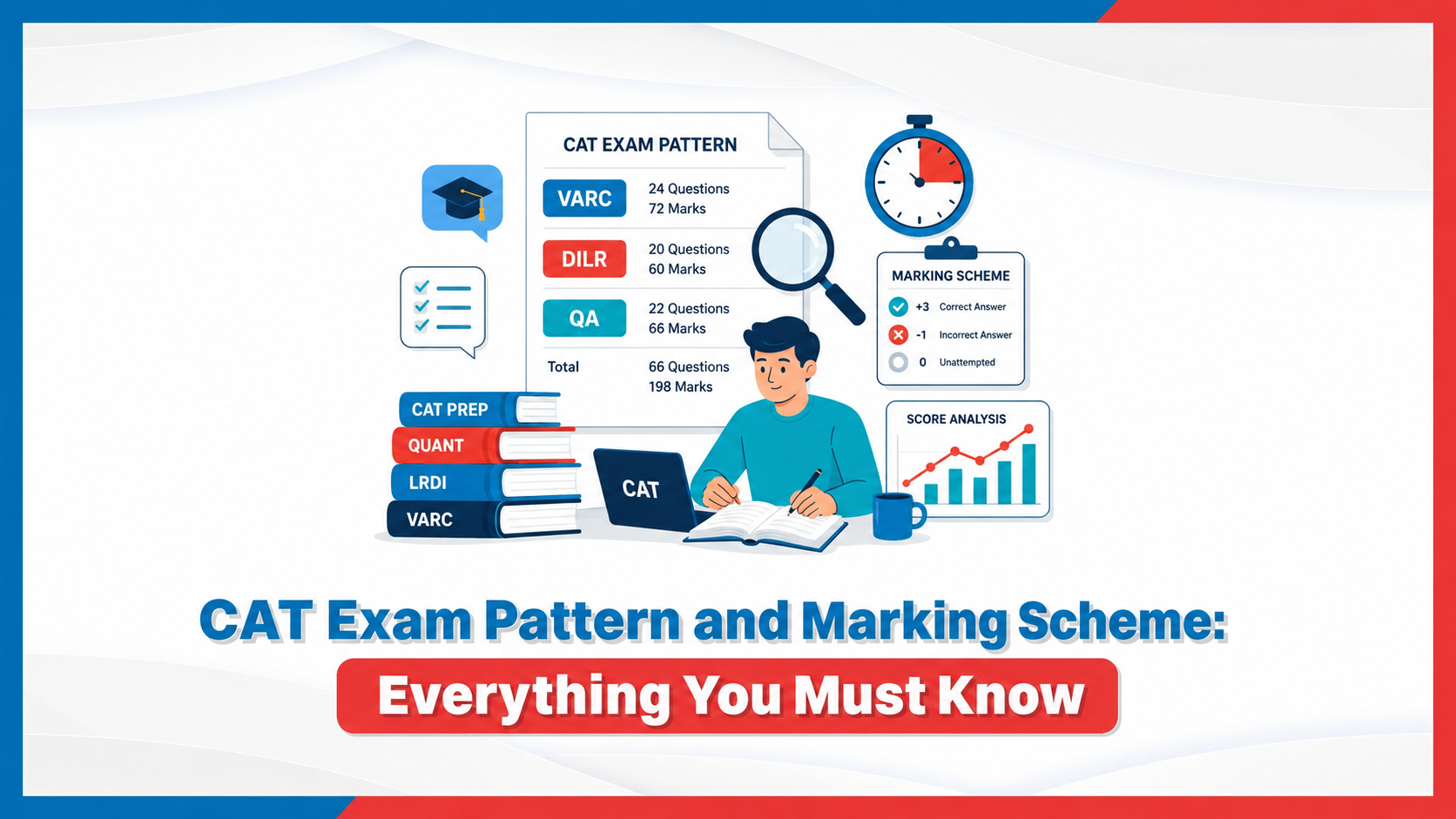
The Common Admission Test (CAT) is the gateway to India’s premier management institutes, including the IIMs, and several other top B-schools. To get into them, candidates are required to sit for the computer-based exam, where the paper is divided into three sections:
-
Verbal Ability and Reading Comprehension (VARC)
-
Data Interpretation and Logical Reasoning (DILR)
-
Quantitative Aptitude (QA)
Although minor changes can be observed in the CAT exam year by year, the overall structure of the examination has remained largely consistent in recent years.
|
Particulars |
Details |
|
Exam Mode |
Computer-Based Test (CBT) |
|
Total Duration |
120 Minutes |
|
Sections |
VARC, DILR, QA |
|
Sectional Time Limit |
40 Minutes Each |
|
Question Types |
MCQs and TITA Questions |
|
Negative Marking |
Applicable for MCQs |
|
Difficulty Level |
Moderate to High |
There is a sectional limit in the CAT exam, which means candidates cannot freely switch between sections. They will have to wait for the timer of the first section to complete to jump it to the next section. This makes the sectional preparation and practice absolutely critical.
CAT Marking Scheme Explained
Understanding the CAT marking scheme is as important as understanding the syllabus. A drop in a few marks could significantly impact your percentile, so it is better to look at the CAT marking scheme prominently. In the CAT exam, candidates can expect two types of questions:
-
Multiple Choice Questions (MCQs)
-
Type In The Answer (TITA) Questions
|
Question Type |
Correct Answer |
Incorrect Answer |
|
MCQ |
+3 Marks |
-1 Mark |
|
TITA |
+3 Marks |
No Negative Marking |
This means that while incorrect MCQ responses attract a penalty, TITA questions do not carry any negative marking. As a result, candidates often attempt TITA questions more confidently during the examination.
Section-Wise Breakdown of CAT
To clear the cutoff and achieve the desired percentile, CAT aspirants must look at the section-wise breakdown, which is discussed below:
Verbal Ability and Reading Comprehension (VARC)
Reading Comprehension forms the major portion of the CAT exam, for which strong reading and reasoning skills are required. To excel in this section, focus on improving reading speed and understanding the style of RC passages by solving Oswaal CAT Previous Year Solved Papers. Focus on improving reading speed and comprehension through regular practice.
|
Topic |
Preparation Priority |
|
Reading Comprehension (RC) |
High |
|
Para Summary |
High |
|
Para Jumbles |
High |
|
Odd One Out |
Medium |
|
Vocabulary in Context |
Medium |
Data Interpretation and Logical Reasoning (DILR)
Often considered the most unpredictable section, so practice a variety of DILR sets regularly rather than focusing on one format. Oswaal CAT Mock Test papers are particularly useful for improving set selection and time management in this section.
|
Topic |
Preparation Priority |
|
Data Tables |
High |
|
Bar & Line Graphs |
High |
|
Caselets |
High |
|
Seating Arrangements |
High |
|
Puzzles |
High |
|
Venn Diagrams & Grouping |
Medium |
Quantitative Aptitude (QA)
Arithmetic and Algebra consistently account for a major share of questions. This section is particularly based on school-level mathematics, where aspirants need to assess numerical ability, mathematical concepts, and problem-solving efficiency.
|
Topic |
Preparation Priority |
|
Arithmetic |
High |
|
Algebra |
High |
|
Geometry |
High |
|
Number Systems |
Medium |
|
Modern Mathematics |
Medium |
|
Mensuration |
Medium |
Concluding Thoughts
Understanding the exam pattern, marking scheme, and section-wise weightage gives you a strategic edge over thousands of fellow aspirants. But knowing the structure alone is not enough; consistent, focused practice is what ultimately separates toppers from the rest. This is where Oswaal CAT Preparation Books become your most trusted companion by offering previous-year trends, extensive practice questions, smart revision tools, and more.
So, your IIM dream deserves more than luck. Equip yourself with the best resources from Oswaal and stay ahead.
FAQs
1. What could be the CAT exam pattern for 2026?
CAT 2026 is a computer-based test for 120 minutes divided into three sections–VARC, DILR, and QA. Each section comes with a 40-minute sectional time limit, and you can expect approximately 65- 70 questions in total.
2. Can we expect negative marking in CAT?
Yes, for MCQ-type questions, 1 mark is deducted for every wrong answer. However, TITA (Type In The Answer) questions carry no negative marking.
3. Which is the toughest section in CAT?
DILR seems to be the most unpredictable and challenging section. But it can be scored well by practicing through Oswaal CAT preparation books.
4. Can I switch between sections during the CAT exam?
No. CAT has a strict sectional time limit. You cannot move from one section to another until the allotted time for the current section is over.
5. How is the CAT score different from a CAT percentile?
Your CAT score is the raw marks you obtain, while your percentile reflects your performance relative to all other test-takers.
Recent Posts
Best ICSE Class 10 Books for Revision and Mock Test Practice
When it comes to the best books for Class 10 ICSE 2027, Oswaal Books are among the top recommendations, prepared around the latest ICSE syllabus with...

UPSC Mains Revision Checklist for GS Paper 1, 2, 3 & 4
The UPSC Civil Services Mains examination tests the knowledge of the candidates across four General Studies papers—GS Paper 1, GS Paper 2, GS...

How Can We Make Studies Fun for Class 2 Kids?
You sit down to study with your class 2 child; after 10 minutes, they begin to fidget, stare at the wall or ask for a break. Sounds familiar? Kids in...
.png)
How do I choose the best CTET books for Paper 1 (Primary Level)?
“Which is the best CTET book to buy?” Most common question aspirants ask. There are so many books in the market that claim to be the best. It’s...

Olympiad Exams Preparation for Class 5 2026-27: Maths, Science, & English Strategy
In the year 2026-27, children will be required to have a slightly better and more structured approach when they are sitting for the Olympiad exams in...
JEE Main 2027 Mock Test Dates: When to Start and How Many Mock Tests to Attempt?
What if you are scoring 180 in mock tests and only 120 in actual JEE Main? Most of the time, the problem is not your preparation, but your mock test...

Best Subject-wise Books for Indian Air Force Group X & Y Exam Preparation
Getting into the Indian Air Force is a dream for many young students across India. Whether you want to join as a technical trade (Group X) or a...

JEE Main 2027 Daily Timetable: How Many Hours Should You Study?
There is one universal question among all the aspirants of JEE: how many hours do I need to study per day to get selected for JEE Main 2027? There is...

Career Options After 12th PCB: Best Courses and Career Paths for Science Students
PCB stream opens doors to dozens of career options, and the decision you make after 12th determines the next few years of your life. Pick courses...

How to Select the Best Math Worksheet Book for Class 6 CBSE?
Class 6 is a very important milestone in the mathematical journey of a student. Concepts get more detailed, questions require more thought, and just...