


CLAT Legal Reasoning Important Topics You Can't Afford to Skip in 2027 Admission Test
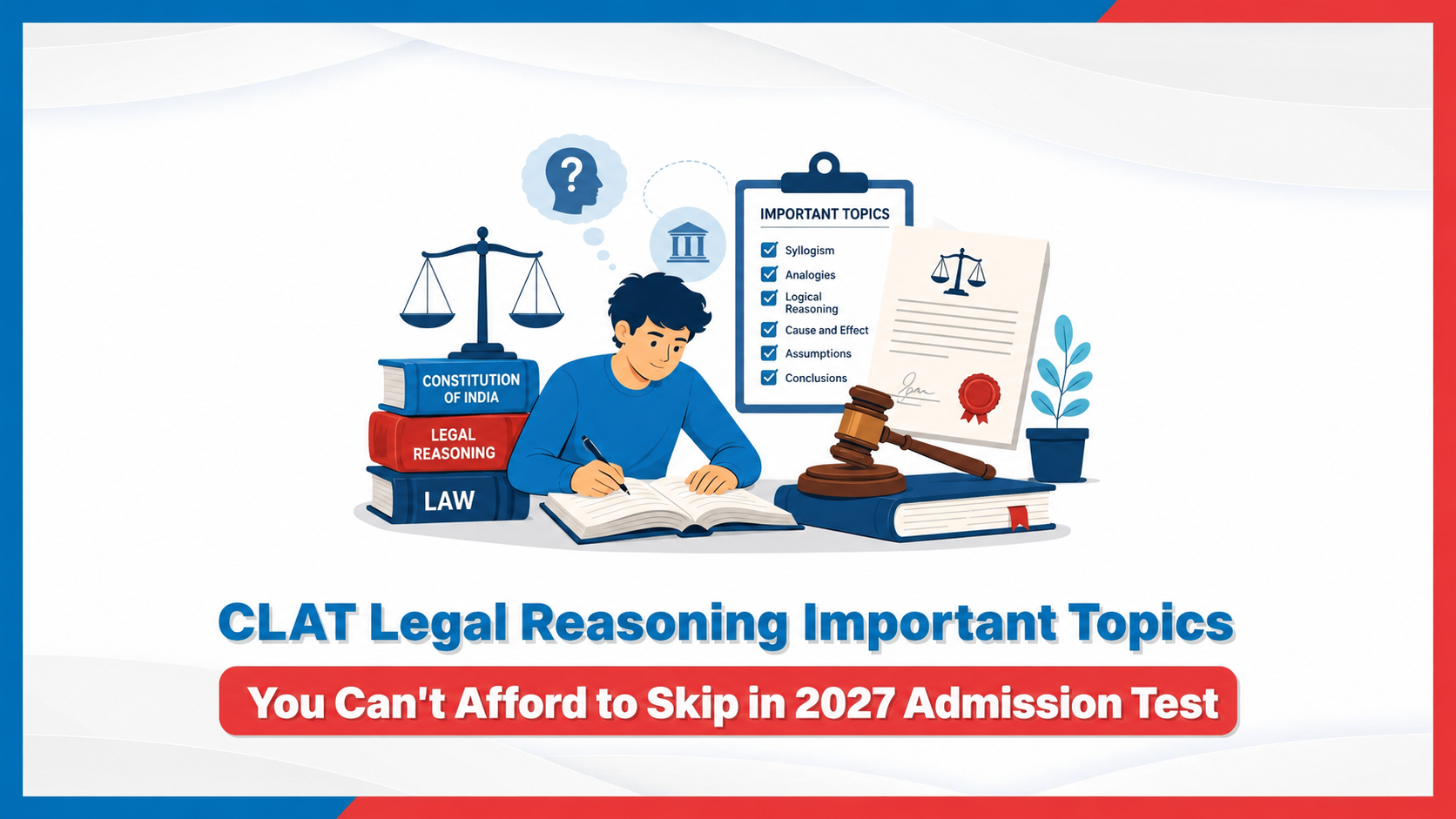
The Common Law Admission Test (CLAT) is one of the most significant tests for students aiming to pursue law studies in India. Every year, thousands of students appear for this test to get into top National Law Universities. This blog is a straightforward guide for those taking the 2027 admission test and one of the most crucial sections — Legal Reasoning.
CLAT gives a significant weightage to Legal Reasoning. By knowing the suitable topics and practicing them with suitable CLAT preparation books and CLAT legal aptitude mock test resources, you can get a very good score. We'll take you through it step by step, in a simple and easy way.
Why is Legal Reasoning So Important in CLAT?
Legal Reasoning is a test of reading a legal principle and applying it to a set of facts. It is not necessary to have a complete knowledge of the laws of India. You need to be a good reader, understander and thinker. This section contains approximately 28-32 questions in the CLAT exam, which is one of the most scoring sections.
Students who do regular practice with CLAT mock test papers and solve the CLAT previous year question paper perform much better. Now let's examine some of the key issues.
Important Topics in CLAT Legal Reasoning
1. Principle-Fact Application
This is the most frequently asked type of questions in CLAT. A legal principle is provided to you and a fact situation is provided. The principle must be applied to the facts and the correct answer found. The principle is always assumed to be true even if it is not according to actual law. Do this type daily to become faster and more accurate.
2. Criminal Law Basics
Crime and punishment, intention and self-defence are recurring topics in CLAT. It is not necessary to read the entire Indian Penal Code. Know the general concepts – what constitutes an offence, what is meant by mens rea (guilty mind) and how the law deals with different scenarios. This has chapters devoted to it in many CLAT exam books.
3. Contract Law
Contract law questions are based on contracts between individuals. These are tested on topics such as offer, acceptance, consideration and breach of contract. Consider it the rules for breaking and making a promise. This area has been a regular feature of CLAT, so do not miss this.
4. Tort Law
The word tort is defined as a civil wrong that causes harm to another. Questions in this section assess your grasp of responsibility and responsibility for care. Negligence, nuisance and strict liability cases occur frequently. By practicing the CLAT previous year question paper sets, you will understand the kind of facts that are provided in the CLAT.
5. Constitutional Law
This topic includes Fundamental Rights, Directive Principles and basic structure of the Indian Constitution. Questions can be related to freedom of speech, right to equality or right to life. Constitutional law questions may be a little tricky, so it's helpful to get a head start and read through good CLAT books that explain it well.
6. Family Law and Property Law
Family and property law issues come up in some years, but not so frequently. Issues such as inheritance, marriage and ownership are significant. Read the best books for CLAT preparation 2026 in simple terms which cover these.
Topic Weightage and Difficulty Chart
This is a brief summary of the concepts and their level of difficulty and importance in the exam.
|
Topic |
Difficulty |
Weightage |
Preparation Tip |
|
Principle-Fact Application |
Medium |
High |
Practice daily with CLAT mock test papers |
|
Criminal Law Basics |
Easy-Medium |
High |
Use CLAT exam books with examples |
|
Contract Law Concepts |
Medium |
Medium |
Refer to CLAT preparation books |
|
Tort Law |
Medium |
Medium |
Solve CLAT previous year question paper |
|
Constitutional Law |
High |
High |
Read CLAT legal aptitude mock test |
|
Family & Property Law |
High |
Low-Medium |
Use best books for CLAT preparation 2026 |
How to Use CLAT Previous Year Question Papers
Many students neglect to read previous year papers and just read theory. That is a mistake. One of the key preparation resources is the CLAT previous year question paper. This is because, the pattern of questions in CLAT doesn't change significantly from one year to the other. All principle-fact questions, all passages, and all types of laws tested are of a similar style.
Solve the previous papers of at least 5-7 years prior to the exam. Time yourself as you solve them. Once complete, review your answers and explain why you may have been incorrect. This review process is more important than just solving the paper.
CLAT Mock Test Papers — Why They Matter
A CLAT legal aptitude mock test is a practice test of the CLAT exam which is similar to the actual CLAT format. These tests are designed to familiarize you with the pressure of exam situations. Your mind must be trained to remain calm and focused during a real exam, which will take 2 hours. Mock tests are designed to do just that.
Frequent practice on CLAT mock test papers also enables you to recognize your weak areas. If you are consistently making mistakes on tort questions, you know where you need to focus more time. Most online platforms offer free and paid mock tests. It is advisable to take 2 to 3 complete mock tests each month while preparing.
6-Month Study Plan for CLAT Legal Reasoning
Consistency is the key to cracking CLAT. Here is a simple six-month plan to help you stay on track.
|
Phase |
What to Study |
Resource |
|
Month 1-2 |
Basic legal principles, Constitutional law |
CLAT books, NCERT basics |
|
Month 3-4 |
Criminal, Contract & Tort Law |
CLAT preparation books, notes |
|
Month 5 |
Previous papers & revision |
CLAT previous year question paper |
|
Month 6 |
Full mock tests & weak areas |
CLAT legal aptitude mock test, CLAT mock test papers |
Tips to Score High in Legal Reasoning
Read the law carefully before examining the facts. Don't use outside information. The principle given is always the rule for that question. Read every day and build up your reading speed – legal passages demand a high level of reading speed. Answer no more than two minutes per question in the exam. If stuck, move on and come back later. Carefully analyse your errors on each mock test – this is where real learning occurs.
Conclusion
Legal Reasoning is not a difficult section when you prepare the correct manner. Pay attention to the principles of law, not to the laws themselves. Refer to the best CLAT preparation books, solve the CLAT previous year question paper and do regular CLAT legal aptitude mock tests. Have a simple study plan and stick to it each day.
The CLAT 2027 Admission Test is the opportunity to secure admission into your desired law school. Begin early, study smart, and rely on the appropriate CLAT books and CLAT mock test papers to gain confidence. You have got this!
Frequently Asked Questions (FAQ)
Q1. How many questions come from Legal Reasoning in CLAT?
There are approximately 28-35 questions in Legal Reasoning out of 120 questions in the CLAT exam. It is one of the most heavily-marked sections.
Q2. How many mock tests should I give before CLAT 2027?
The ideal amount of full-length mock tests is 20-25. Take a CLAT legal aptitude mock test series for targeted legal reasoning practice.
Q3. Is legal reasoning hard for beginners?
Not really. This might be confusing at first, but after knowing the principle-fact method, it will be easier. Begin with easy questions in your CLAT preparation books and then go to difficult questions.
Q4. Can I prepare for CLAT without coaching?
es, many students have self-studied CLAT. Utilize good CLAT exam books, solve CLAT mock test papers on regular basis and be consistent with your schedule. Coaching is more important than self-discipline.
Recommended Books | Study Materials
Recent Posts
Best ICSE Class 10 Books for Revision and Mock Test Practice
When it comes to the best books for Class 10 ICSE 2027, Oswaal Books are among the top recommendations, prepared around the latest ICSE syllabus with...

UPSC Mains Revision Checklist for GS Paper 1, 2, 3 & 4
The UPSC Civil Services Mains examination tests the knowledge of the candidates across four General Studies papers—GS Paper 1, GS Paper 2, GS...
How Can We Make Studies Fun for Class 2 Kids?
You sit down to study with your class 2 child; after 10 minutes, they begin to fidget, stare at the wall or ask for a break. Sounds familiar? Kids in...
.png)
How do I choose the best CTET books for Paper 1 (Primary Level)?
“Which is the best CTET book to buy?” Most common question aspirants ask. There are so many books in the market that claim to be the best. It’s...

Olympiad Exams Preparation for Class 5 2026-27: Maths, Science, & English Strategy
In the year 2026-27, children will be required to have a slightly better and more structured approach when they are sitting for the Olympiad exams in...
JEE Main 2027 Mock Test Dates: When to Start and How Many Mock Tests to Attempt?
What if you are scoring 180 in mock tests and only 120 in actual JEE Main? Most of the time, the problem is not your preparation, but your mock test...

Best Subject-wise Books for Indian Air Force Group X & Y Exam Preparation
Getting into the Indian Air Force is a dream for many young students across India. Whether you want to join as a technical trade (Group X) or a...
JEE Main 2027 Daily Timetable: How Many Hours Should You Study?
There is one universal question among all the aspirants of JEE: how many hours do I need to study per day to get selected for JEE Main 2027? There is...

Career Options After 12th PCB: Best Courses and Career Paths for Science Students
PCB stream opens doors to dozens of career options, and the decision you make after 12th determines the next few years of your life. Pick courses...
How to Select the Best Math Worksheet Book for Class 6 CBSE?
Class 6 is a very important milestone in the mathematical journey of a student. Concepts get more detailed, questions require more thought, and just...