


How to Build a 100-Day Revision Calendar for JEE Main Session 1
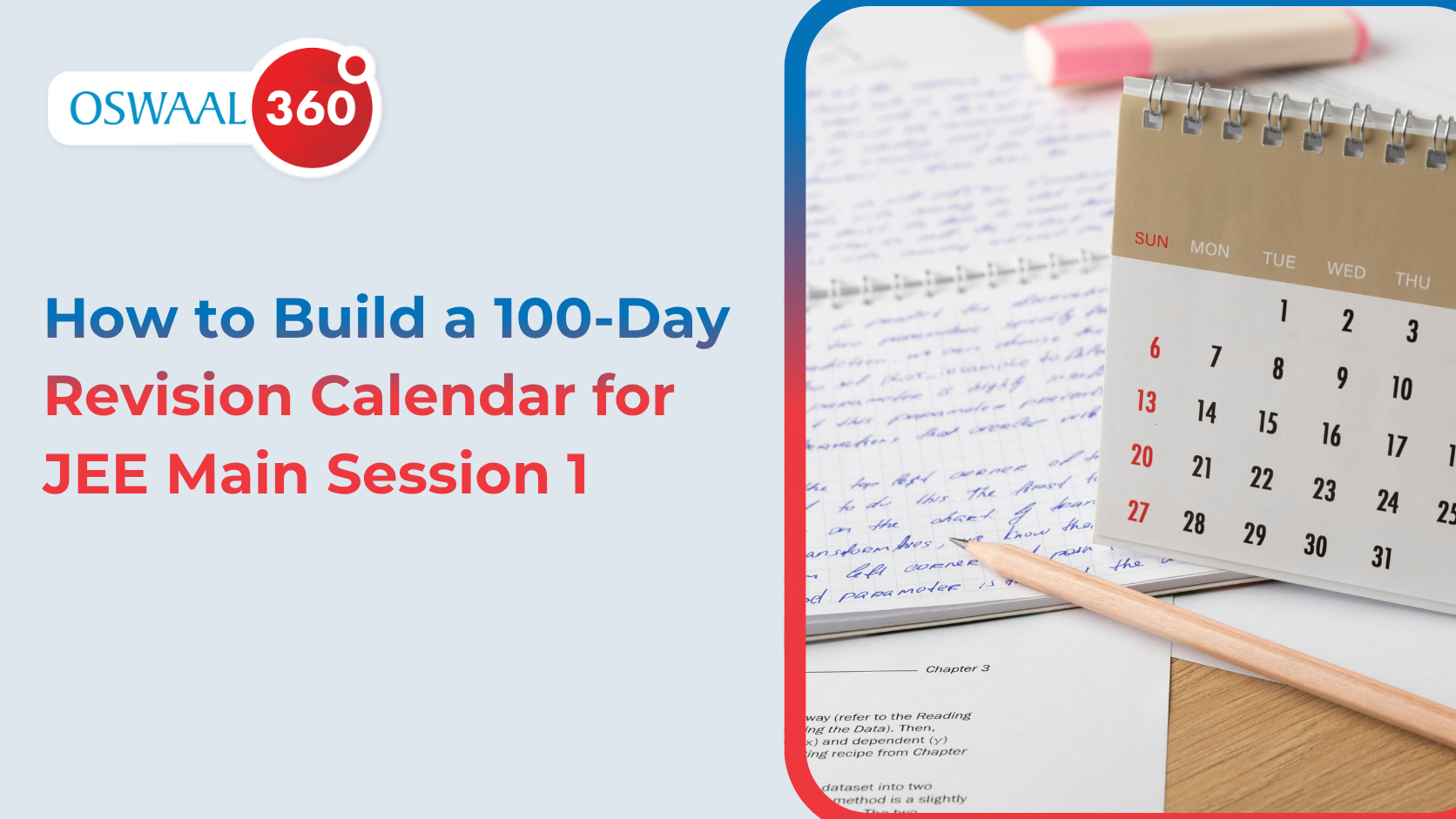
100 days are still left for JEE Main Session 1? Don't worry! If you have a clear plan, you can make all the changes in time without stressing yourself out. This blog will guide you through the process of creating your very own 100-day revision calendar, and the books and practice techniques to help you get a better score.
Why a 100-Day Plan Works Best for JEE Main
JEE Main covers three subjects — Physics, Chemistry, and Maths — and each has many chapters. Trying to edit everything without a strategy might lead you to overlook some points or to spend too much time on others.
A 100-day calendar helps you:
-
Covers every chapter at least once.
-
Provide time for practice and simulated tests
-
Avoid last-minute panic
-
Easily monitor progress on a daily basis
Many toppers use this type of planning as it helps them to divide a huge and frightening target into small, achievable tasks on a daily basis (NTA, n.d.).
Step 1: Divide Your 100 Days into Phases
The first thing you need to do is to divide your 100 days into smaller chunks. This makes the plan simple to follow and not so exhausting.
|
Phase |
Days |
Focus Area |
|---|---|---|
|
Phase 1 |
Day 1–40 |
Complete chapter-wise revision |
|
Phase 2 |
Day 41–70 |
PYQ practice and weak topic fixing |
|
Phase 3 |
Day 71–90 |
Full mock tests and timing practice |
|
Phase 4 |
Day 91–100 |
Quick revision and formula recap |
Step 2: Chapter-wise Revision Using Question Banks
In the first phase, read the chapters sequentially, rather than randomly. A good chapterwise question bank for JEE Mains allows you to revise theory and solve the questions of the same chapter together so that you can grasp the concept well.
Tips for this step:
1. Select one chapter a day or two days, depending on difficulty.
2. Read short notes first and then solve questions from a question bank of JEE main.
3. Indicate the incorrect answers to questions for revision.
4. Have a little formula book and difficult ideas.
This approach lays a solid foundation before you practice with a timer.
Step 3: Practice with PYQs (Previous Year Questions)
After revision of the chapter, the next step is to solve the previous year papers. A JEE mains PYQ book or a JEE mains PYQ chapterwise book will be very helpful here as it will give you an idea about the questions that are asked in the actual exam.
Why PYQs matter:
1. They demonstrate the actual level of challenge of the examination.
2. They help you to grasp repeated ideas.
3. They increase your typing speed and accuracy.
4. They eliminate surprises at exam time.
|
PYQ Practice Method |
Benefit |
|---|---|
|
Chapter-wise PYQs |
Strengthens concept clarity |
|
Year-wise Full Papers |
Builds real exam experience |
|
Mixed Practice Sets |
Improves speed across topics |
Step 4: Take Regular Mock Tests
Last few weeks are very important for mock tests. Solving an NTA JEE mains mock test enables you to familiarize yourself with the actual exam pattern, timing and computer-based test interface.
Simple mock test strategy:
• Take one full mock test every week during Phase 2
• Double the number of mock tests to 2 per week in Phase 3
• Analyze mistakes after each test
• Record and correct time management problems
Mock tests prepare students for the actual exam, giving them confidence and decreasing exam anxiety.
Best Books to Support Your 100-Day Plan
The right books can help your revision be quicker and more effective. Numerous students are looking for the best books that can provide them with theory, practice questions and previous year papers all in one.
The set of books for objective JEE main book will be helpful most of the time because it provides the revision of concepts in a quick way and also has questions of objective type which are similar to the actual exam format.
Many students find that the chapter-wise question banks and PYQ based practice material in a simple and well organised format of series like Oswaal Books is helpful for short revision periods such as 100 days plan.
|
Book Type |
Best For |
|---|---|
|
Objective JEE Main Books |
Quick concept + practice revision |
|
Chapterwise PYQ Books |
Topic-wise previous year practice |
|
Full Question Bank |
Wide range of practice questions |
|
Mock Test Series |
Real exam simulation |
Sample 100-Day Revision Calendar (Table)
Here's a basic template of a calendar to follow or customize as per your strengths and weaknesses.
|
Day Range |
Activity |
|---|---|
|
Day 1–15 |
Physics chapter-wise revision |
|
Day 16–30 |
Chemistry chapter-wise revision |
|
Day 31–40 |
Maths chapter-wise revision |
|
Day 41–55 |
PYQ practice (chapter-wise) |
|
Day 56–70 |
Full-length PYQ papers |
|
Day 71–90 |
Weekly mock tests + analysis |
|
Day 91–97 |
Formula and short notes revision |
|
Day 98–100 |
Light revision and rest |
Common Mistakes to Avoid During Revision
• Topics that are introduced too near to the examination date.
• Avoid missing out on the analysis of mock tests.Don't miss out on mock test analysis.
• Not following up on weak chapters
• Failure to include or include too few subjects in a project
• Studying without breaks and becoming tired.
FAQs
Q1. Is 100 days enough to revise for JEE Main?
Yes, 100 days is sufficient as long as you have a proper phase-wise plan and adhere to daily study and practice.
Q2. Which book is best for PYQ practice in JEE Main?
A JEE mains PYQ chapterwise book will be useful as it will allow you to practice the previous year questions by topic.
Q3. How many mock tests should I take before JEE Main?
It is advisable for students to complete 15-20 full mock tests prior to the exam, with more tests as the exam approaches.
Q4. Should I focus more on NCERT or question banks?
Both are important. NCERT lays the foundation of your basics and a good question bank and PYQ book will assist you in practicing exam-level questions.
Q5. What should I do in the last 10 days before JEE Main?
Just revise, formulas and short notes. Do not begin new topics at this time.
Summary
With a proper revision plan of 100 days, it becomes easier and less stressful to prepare for JEE Main. You can revise smartly and confidently by dividing the days into phases, using a good chapterwise question bank for JEE Mains, practising with PYQ books and taking regular NTA JEE mains mock tests. The selection of the best books for JEE Mains combined with daily hard work makes the success of the first session much more possible.
Recommended JEE Main Books and Study Materials
Recent Posts
Best ICSE Class 10 Books for Revision and Mock Test Practice
When it comes to the best books for Class 10 ICSE 2027, Oswaal Books are among the top recommendations, prepared around the latest ICSE syllabus with...

UPSC Mains Revision Checklist for GS Paper 1, 2, 3 & 4
The UPSC Civil Services Mains examination tests the knowledge of the candidates across four General Studies papers—GS Paper 1, GS Paper 2, GS...

How Can We Make Studies Fun for Class 2 Kids?
You sit down to study with your class 2 child; after 10 minutes, they begin to fidget, stare at the wall or ask for a break. Sounds familiar? Kids in...
.png)
How do I choose the best CTET books for Paper 1 (Primary Level)?
“Which is the best CTET book to buy?” Most common question aspirants ask. There are so many books in the market that claim to be the best. It’s...

Olympiad Exams Preparation for Class 5 2026-27: Maths, Science, & English Strategy
In the year 2026-27, children will be required to have a slightly better and more structured approach when they are sitting for the Olympiad exams in...
JEE Main 2027 Mock Test Dates: When to Start and How Many Mock Tests to Attempt?
What if you are scoring 180 in mock tests and only 120 in actual JEE Main? Most of the time, the problem is not your preparation, but your mock test...

Best Subject-wise Books for Indian Air Force Group X & Y Exam Preparation
Getting into the Indian Air Force is a dream for many young students across India. Whether you want to join as a technical trade (Group X) or a...
JEE Main 2027 Daily Timetable: How Many Hours Should You Study?
There is one universal question among all the aspirants of JEE: how many hours do I need to study per day to get selected for JEE Main 2027? There is...
Career Options After 12th PCB: Best Courses and Career Paths for Science Students
PCB stream opens doors to dozens of career options, and the decision you make after 12th determines the next few years of your life. Pick courses...
How to Select the Best Math Worksheet Book for Class 6 CBSE?
Class 6 is a very important milestone in the mathematical journey of a student. Concepts get more detailed, questions require more thought, and just...