


How To Choose The Best Reference Book For CBSE Class 10 Preparation?
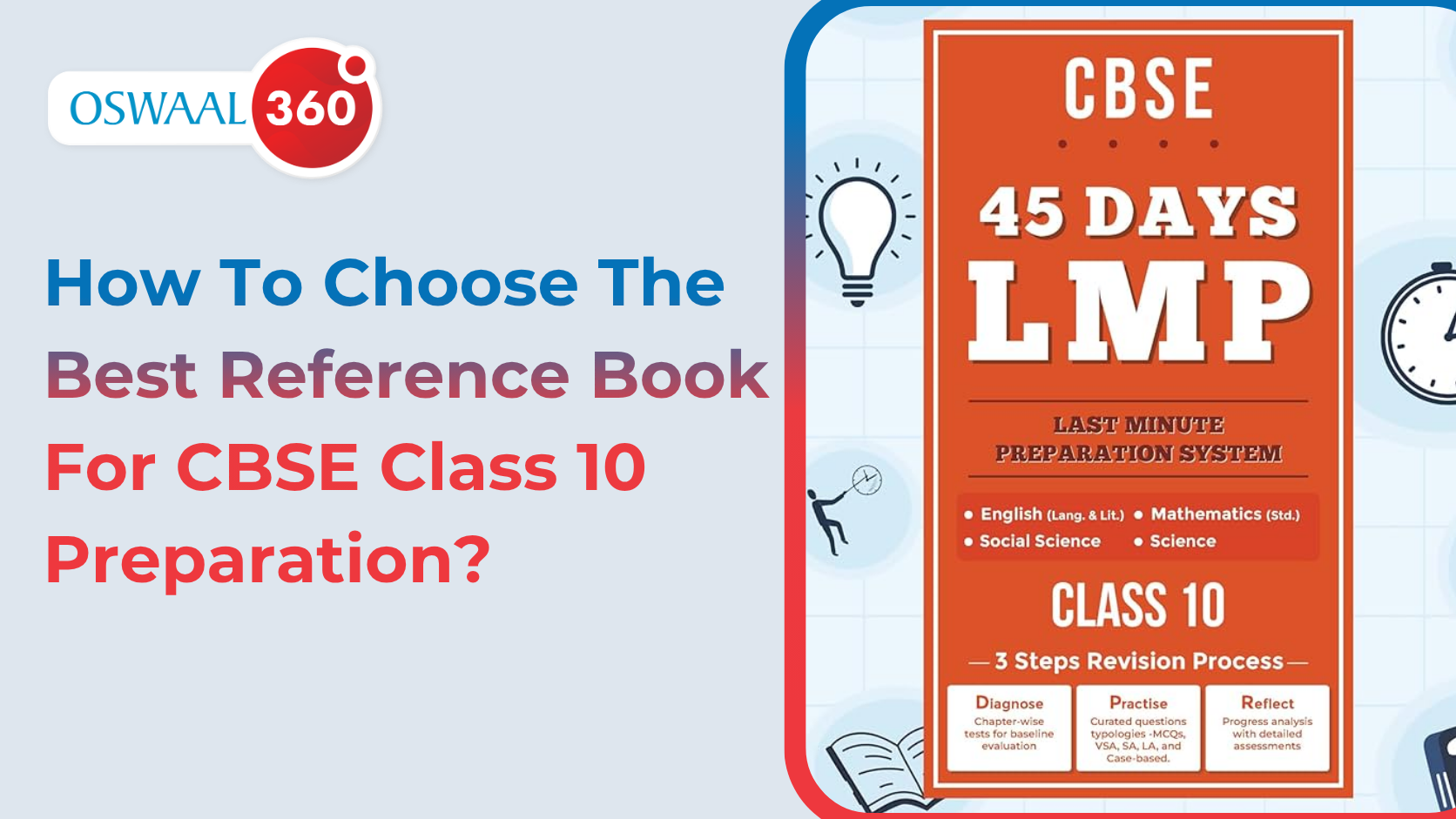
The Class 10 board exams are one of the first major academic milestones in a student's life. Your marks in Class 10 will be on applications and records for years after. So your preparation matters - and your study material matters as well.
For most students, NCERT textbooks are the right call to begin with. The CBSE syllabus is derived from NCERT. NCERT alone is not always enough to prepare for board exams thoroughly. That’s where reference books are useful.
NCERT cannot be replaced by reference books. It is a companion that helps you understand concepts more clearly, practise more questions, and get familiar with the structure of the board exam. NCERT tells you what to study. A good reference book will help you study it well.
Why Reference Book is Important for Class 10 CBSE
One particular gap NCERT leaves, and most students feel it during revision or mock tests. Reference tomes are where it comes in:
More clarity. The NCERT explanations are precise, which is good for coverage but not necessarily sufficient for understanding. A good reference book will explain the same concept in more detail with examples that make it easier to understand.
More practice problems. There are very few questions in NCERT exercises. In the board exams, the same concepts are tested from different angles. Reference books give you more practice material, like questions at the end of every chapter, mixed sets, and different question formats.
Understanding of pattern of board exam. Knowing the syllabus is one thing. Another is to get a feel for how questions are presented in the real exam. That’s what a reference book, as per the latest CBSE pattern, prepares you for.
Time management and review assistance. Good reference books are summary notes and quick revision aids, which save time in the last weeks before exams.
Important Factors to Choose Best Reference Book for Class 10 CBSE
Not all reference books on the shelf are worth your time. Before you decide on one, take a look at:
CBSE Latest Syllabus and Exam Pattern. The CBSE revises its syllabus and question paper pattern from time to time. Always opt for a book relevant to the current syllabus. An outdated book can waste your time on things that no longer weigh.
Easy language and easy explanations. If you have to fight with the language to grasp a concept, the book is not doing its job. Look for books that explain ideas in simple language without dumbing down the content.
Chapter-wise Practice Questions. A good reference book will organise practice questions by chapter so you can test yourself directly after studying a topic. This encourages retention and provides structure to revision.
Last Year Question Papers. Books with solved past papers give you a real insight into what the board actually asks. This is one of the most useful features to look for.
Sample papers along with solutions. The sample papers will give you an idea of the actual exam conditions. Solutions tell you where you have gone wrong in your answers.
Important Formulas and Revision Notes. A book with chapter summaries, important terms, and formula lists saves a lot of time for last-minute revision.
Class 10 Reference Books Selection Guide by Subject
A reference book has to do different things for different subjects. Here’s a quick breakdown:
English. Choose an English reference book class 10 that clearly explains the rules of grammar, gives guidance on writing letters and essays, and provides practice reading passages of different kinds.
Hindi. Good Hindi reference book class 10 coverage of Vyakaran, explanation of poems and prose from NCERT chapters & sample answers for long form questions are some of the qualities of a good Hindi reference book.
Science. Sciences Science is divided into three parts Physics, Chemistry, and Biology. Your reference book should have all three with diagrams, labelled illustrations, and concept-wise practice questions. Numericals in Physics and Chemistry require special attention.
Maths. Maths: Practice volume is more important than the theory. Choose a book that has a lot of solved examples and unsolved exercises in each chapter. It’s important to show the working, to have the step-by-step solutions, and not just the final answer.
Social sciences. SST consists of History, Geography, Political Science & Economics. A reference book for this subject should be well-structured, with each section properly organised, including map work, practice, and structured answers to short and long questions.
Features of Best Guide Book for CBSE Class 10
When you find a reference book that hits most of these points, you're in good shape:
-
Chapter-wise NCERT-based concept explanation
-
NCERT-based questions with answers. Full coverage.
-
Objective-type and Subjective-type questions
-
Now regularly incorporated by CBSE, Assertion-Reason, and Case-based questions
-
Self-assessment tests at the end of each chapter to help you keep track of your progress
Mistakes to Avoid When Selecting Reference Books
Some mistakes that students make that end up hurting their preparation:
Purchasing way too many books. More books don't mean better preparation. Switching back and forth between five different guides is confusing, and you won’t get full coverage of each. Stick to one good reference book per subject.
Syllabus alignment not considered. Any book that goes beyond the present CBSE syllabus is a waste of your time. Always check the edition and verify that it matches the latest curriculum.
Too much emphasis on theory. If you read and re-read theory without doing any practice questions, you will get a false sense of readiness. “Real learning happens in practice.
Skip previous year questions. Students frequently underestimate previous papers. They mirror the exam's level of difficulty and question types. A book without this is not complete.
Advantages of Using the Correct Class 10 Reference Book
When you learn from the right material like Oswaal CBSE One For All Class 10, the difference shows up in your results:
Thorough understanding of concepts. Better explanations = better retention. You know the why behind answers, not just the what.
More exam confidence. Students who practise with a well-structured reference book enter the exam hall knowing the type of questions to expect. That familiarity cuts down on exam anxiety.
More effective answer writing skills. Good reference books will teach you how to structure answers, what to include, how much to write, and how to present information for maximum marks.
Improved marks in board exams. All of the above sums up. Consistent practice with quality materials will show up in your final score.
Conclusions
Choosing the right reference book for CBSE Class 10 isn’t tricky, but it needs a moment of thought. The best book would be the one that is aligned with the syllabus, explains the concepts well, provides enough practice, and includes past papers along with sample tests.
You don't need a bunch of books. You need the right one, and you need to use it consistently.” Start with NCERT, include one good reference book for each subject, and keep practicing. That combination is a winner.
FAQs
Q1. Is NCERT sufficient for CBSE Class 10 boards?
First, you have to complete NCERT, for foundation. But a reference book offers real value for more practice, better concept clarity, and to be familiar with the exam pattern.
Q2. How many reference books should a class 10 student refer to per subject?
One will suffice. If you use more than one book for the same subject, it causes confusion and incomplete preparation. Pick the best CBSE guide for class 10 and study it thoroughly.
Q3. Must I buy a new edition of the reference book every year?
Yes, if the syllabus or exam pattern has been changed by CBSE. Be sure to check the syllabus for the current academic year before buying the book.
Recent Posts
Best ICSE Class 10 Books for Revision and Mock Test Practice
When it comes to the best books for Class 10 ICSE 2027, Oswaal Books are among the top recommendations, prepared around the latest ICSE syllabus with...

UPSC Mains Revision Checklist for GS Paper 1, 2, 3 & 4
The UPSC Civil Services Mains examination tests the knowledge of the candidates across four General Studies papers—GS Paper 1, GS Paper 2, GS...
How Can We Make Studies Fun for Class 2 Kids?
You sit down to study with your class 2 child; after 10 minutes, they begin to fidget, stare at the wall or ask for a break. Sounds familiar? Kids in...
.png)
How do I choose the best CTET books for Paper 1 (Primary Level)?
“Which is the best CTET book to buy?” Most common question aspirants ask. There are so many books in the market that claim to be the best. It’s...

Olympiad Exams Preparation for Class 5 2026-27: Maths, Science, & English Strategy
In the year 2026-27, children will be required to have a slightly better and more structured approach when they are sitting for the Olympiad exams in...
JEE Main 2027 Mock Test Dates: When to Start and How Many Mock Tests to Attempt?
What if you are scoring 180 in mock tests and only 120 in actual JEE Main? Most of the time, the problem is not your preparation, but your mock test...

Best Subject-wise Books for Indian Air Force Group X & Y Exam Preparation
Getting into the Indian Air Force is a dream for many young students across India. Whether you want to join as a technical trade (Group X) or a...
JEE Main 2027 Daily Timetable: How Many Hours Should You Study?
There is one universal question among all the aspirants of JEE: how many hours do I need to study per day to get selected for JEE Main 2027? There is...
Career Options After 12th PCB: Best Courses and Career Paths for Science Students
PCB stream opens doors to dozens of career options, and the decision you make after 12th determines the next few years of your life. Pick courses...
How to Select the Best Math Worksheet Book for Class 6 CBSE?
Class 6 is a very important milestone in the mathematical journey of a student. Concepts get more detailed, questions require more thought, and just...