


NDA 2026 Medical Rejection: Common Reasons and How to Avoid Them
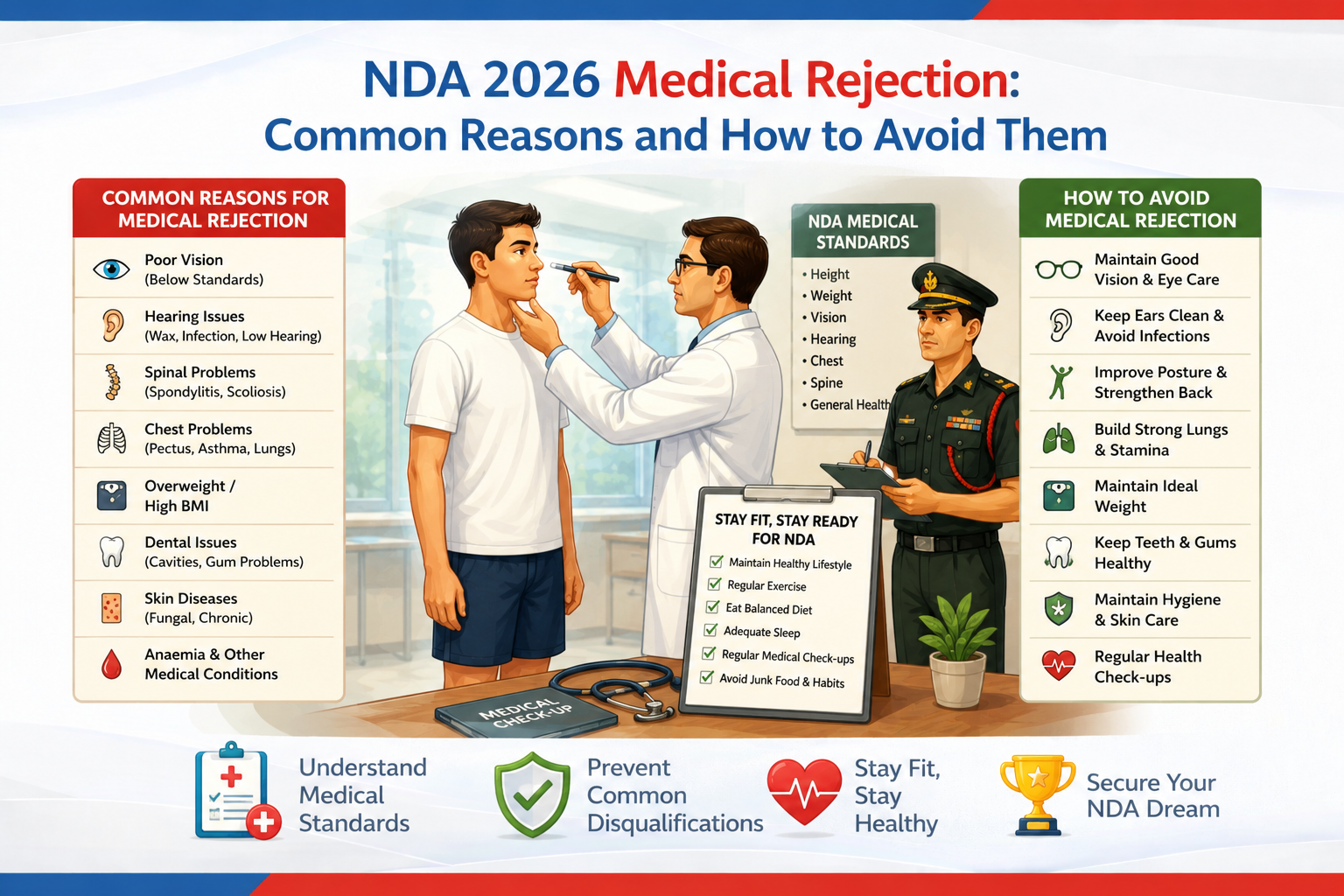
Imagine putting in hard work for months, clearing the NDA written exam, surviving the SSB pressure, and then getting rejected in the medicals. That’s one of the most heartbreaking things for an NDA aspirant, and we understand this better. It is not easy to compete with lakhs of aspirants, sacrifice comfort, study for hours, work on personality development, and push through pressure at every step.
After coming so close to the destination, getting rejected from the NDA medical test 2026 due to a medical issue or minor negligence feels literally devastating. What makes it even more painful is that many of these problems are preventable with proper awareness and early preparatory steps. This crisp NDA preparation guide would take you through all the wheres and whats of the NDA medical test 2026–-from eligibility standards, common rejection reasons, fitness parameters, and preparation tips that every serious NDA aspirant should know beforehand.
Must Read - When is the NDA Exam Conducted?
What is an NDA medical exam?
The NDA medical examination is one of the most rigorous fitness screenings in India. Conducted at designated Military Hospitals after SSB recommendation, it covers vision, hearing, flat feet, knock knees, dental health, skin conditions, and more. The blunder NDA aspirants make–they put their entire focus on collecting the best NDA exam preparation booksfor the written exam, which is not bad, but neglecting their physical health initially is something they have to pay for later on.
The purpose of the NDA medical test 2026 is not to reject candidates, but to ensure that future officers are physically capable of handling the demanding lifestyle, training conditions, and responsibilities of the Armed Forces. Here are the NDA physical standards parameters on which the candidates are tested to choose the absolute best from the rest:
- Vision and eyesight standards
- Hearing ability
- Height and weight measurements
- Flat feet and knock knees
- Dental and oral health
- Spine and posture
- Skin conditions and allergies
- Chest expansion and respiratory health
- Overall physical and mental fitness
Detailed Breakdown of NDA Medical Test 2026
The medical board is conducted at the nearest Armed Forces Military Hospital after SSB results are declared. It usually takes place for 4 to 5 days and is under the vigilance of a panel of specialist service medical officers. Before the actual medical testing drill begins, NDA aspirants need to fill the AFMSF-2 form (Armed Forces Medical Services Form-2), the official medical history document that organises all specialist investigations.
Step 1– Registration at the Military Hospital
NDA aspirants are assigned a medical chest number with a red cross insignia, which they need to wear at all times on campus. A Staff Surgeon will guide the candidates to fill the AFMSF-2 form, which records personal details, complete medical history, and any pre-existing conditions.
Step 2– Day-by-Day Medical Examinations
Day 1: The first day is entirely dedicated to laboratory and imaging investigations, which include a blood test, urine test, X-ray, and ultrasound. Candidates must fast before Day 1 testing; they need not eat anything before reporting on the first morning.
Day 2: The entire second day is dedicated to ophthalmological assessment. Uncorrected vision must be 6/6 in one eye and 6/9 in the other. Colour vision is tested using the Ishihara chart — any deficiency is typically disqualifying for most NDA branches. Candidates with glasses are also assessed for post-correction acuity, and a fundus examination checks the health of the retina. Eat foods rich in Vitamin A and antioxidants in the weeks before.
Day 3: This day is booked for ENT examination ( Ear, Nose, Throat). The audiometry test checks hearing sensitivity at multiple frequencies — even minor loss at higher frequencies can be flagged. The nasal passages are examined for deviated septum (DNS); a minor deviation without functional impact may be acceptable, but significant DNS usually requires a surgical history. Tonsil enlargement and overall throat health are also assessed.
Day 4: The primary focus is on the surgical and systemic examination, where doctors assess posture, spine alignment, flat feet, knock knees, bow legs, chest expansion, blood pressure, BMI, and overall cardiovascular fitness.
Day 5: The final day includes a dental examination to assess oral health, missing teeth, decay, and bite alignment. After all specialist assessments are completed, the Medical Board reviews the overall medical profile and declares candidates as Fit, Temporary Unfit, or Permanent Unfit. Female candidates additionally undergo a gynaecological examination as per AFMS guidelines.
Step 3– Medical Board Outcomes
There can be 3 possible outcomes after the board conference–Fit, Temporary Unfit, & Permanent Unfit.
Step 4– The Appeal & Review Process
Being declared medically unfit is not always the end of the journey. Candidates have a structured three-level appeal system available.
Special Medical Board (SMB)
This is the initial medical board conducted during the 4–5 day examination process at the military hospital. It gives the first fitness decision.
Appeal Medical Board (AMB)
Candidates declared permanently unfit can apply for an AMB within 42 days by paying the prescribed fee. The examination is conducted at designated Command Hospitals across India.
Review Medical Board (RMB)
If a candidate is again declared unfit in the AMB, a final appeal can be made through the RMB. The decision of the RMB is considered final.
Top 6 Reasons For Medical Rejection
- Poor Eyesight & Refractive Errors: Out of all NDA physical standards, vision criteria are way too strict. High myopia, hypermetropia, or colour blindness lead to frequent rejection.
- Flat Feet (Pes Planus): The armed forces look for a healthy arch to ensure candidates are fit for physical training and field duties. Grade II and Grade III flat feet typically lead to outright rejection.
- Underweight or Overweight BMI: To match the NDA eligibility criteria in terms of medical conditions, aspirants are asked to maintain a perfect height-to-weight ratio, otherwise declared unfit.
- Hearing Deficiency: Hearing is tested in both ears. Even minor loss in higher frequencies can result in rejection, particularly for technical branches.
- Skin Conditions: Tattoos, while not always disqualifying, must be within permissible size and location limits as per the latest notification. Psoriasis, severe acne, eczema, and chronic dermatological conditions are commonly flagged.
- Dental Issues: Missing teeth, poor alignment, and significant decay can result in rejection or a temporary unfit category pending corrective treatment.
How to Avoid NDA Medical Rejection in 2026
Many medical rejections can be avoided through early preparation and regular health monitoring. Follow these simple steps:
- Get a full medical check-up early to identify and correct any issues well before the NDA selection process.
- Maintain good eyesight through regular eye examinations and a healthy diet rich in Vitamin A.
- Stay within the prescribed height-weight standards by following a balanced diet and exercising regularly.
- Monitor foot and leg health to detect flat feet or knock knees at an early stage.
- Protect your hearing by avoiding excessive noise exposure and treating ear infections promptly.
- Maintain good dental hygiene and address cavities, gum problems, or alignment issues in advance.
- Treat skin conditions early and follow the Armed Forces' guidelines regarding tattoos.
- Keep medical records ready for any past treatments or surgeries.
Are You a Teacher? For Latest Updated FREE NDA Specimen Sample Books for Teachers- Click Here
Conclusion
For every NDA aspirant, wearing the uniform is an emotion that words can’t explain. It’s a dream built on years of sacrifice, discipline, and determination. Throughout the learning journey, candidates go through days of self-doubt, intense preparation, and countless challenges, yet continue with the same passion to achieve their goal. During that phase, the right NDA exam preparation books, such as those of Oswaal Books, can make the learning journey way smoother. It offers previous years’ trends, chapter-wise & topic-wise extensive practice questions, chapter summaries, mind-maps and more. These exclusive features make these books a must-include purchase in the NDA preparation journey for sure-shot success.
Equally important is to take care of the NDA eligibility criteria and the required medical standards. Because if this is ignored, it costs you the dream when you are very close to the final destination. Keep your diet on track; tick the checkboxes that include eyesight, hearing power, colour blindness, flat feet, knock-knees, and more. So, keep the mindset of preparing not just for the exam, but for the entire journey.
As the saying goes, "A dream does not become reality through magic; it takes sweat, determination, and hard work." With the right preparation, a positive mindset, and an unshakable belief in yourself, no goal is too far away. Stay committed to your dream, and when the opportunity arrives, be ready to wear the uniform with pride and honour.
FAQs
1. What could be the vision requirement for NDA 2026?
For most branches, uncorrected visual acuity must be 6/6 in the better eye and 6/9 in the worse eye. The Air Force branch has even stricter standards, and candidates should verify the current notification before applying.
2. Can I appear for NDA if I have flat feet?
Grade I flat feet may be acceptable depending on the medical board’s assessment. Grade II and Grade III flat feet are generally disqualifying. Early physiotherapy and arch-strengthening exercise can improve the condition if started early enough.
3. Is LASIK surgery allowed in the NDA selection process 2026?
LASIK is conditionally acceptable for the Army and Navy in some cases, but the Air Force branch has much stricter rules. To be more specific about this, you must look at the latest official notification.
4. What happens if I am declared temporarily unfit?
Generally, temporary unfit is given for conditions like dental issues or minor infections. A temporary unfit status doesn’t mean that you are disqualified; instead, it means that you will be given time to correct the medical issue. You may be re-examined after the deficiency is treated.
5. Are tattoos allowed in the NDA?
Tattoos are permitted only on certain body parts and within size limits. Tattoos on the face, neck, hands, or areas visible in uniform are generally not acceptable. For the latest updates, always refer to the official notification released with the branch-specific guidelines.
6. Can a candidate with colour blindness join the NDA?
Colour blindness is disqualifying for most NDA branches, and there are no corrective solutions currently accepted by the medical board.
Recent Posts

Best ICSE Class 10 Books for Revision and Mock Test Practice
When it comes to the best books for Class 10 ICSE 2027, Oswaal Books are among the top recommendations, prepared around the latest ICSE syllabus with...

UPSC Mains Revision Checklist for GS Paper 1, 2, 3 & 4
The UPSC Civil Services Mains examination tests the knowledge of the candidates across four General Studies papers—GS Paper 1, GS Paper 2, GS...

How Can We Make Studies Fun for Class 2 Kids?
You sit down to study with your class 2 child; after 10 minutes, they begin to fidget, stare at the wall or ask for a break. Sounds familiar? Kids in...
.png)
How do I choose the best CTET books for Paper 1 (Primary Level)?
“Which is the best CTET book to buy?” Most common question aspirants ask. There are so many books in the market that claim to be the best. It’s...

Olympiad Exams Preparation for Class 5 2026-27: Maths, Science, & English Strategy
In the year 2026-27, children will be required to have a slightly better and more structured approach when they are sitting for the Olympiad exams in...
JEE Main 2027 Mock Test Dates: When to Start and How Many Mock Tests to Attempt?
What if you are scoring 180 in mock tests and only 120 in actual JEE Main? Most of the time, the problem is not your preparation, but your mock test...

Best Subject-wise Books for Indian Air Force Group X & Y Exam Preparation
Getting into the Indian Air Force is a dream for many young students across India. Whether you want to join as a technical trade (Group X) or a...

JEE Main 2027 Daily Timetable: How Many Hours Should You Study?
There is one universal question among all the aspirants of JEE: how many hours do I need to study per day to get selected for JEE Main 2027? There is...

Career Options After 12th PCB: Best Courses and Career Paths for Science Students
PCB stream opens doors to dozens of career options, and the decision you make after 12th determines the next few years of your life. Pick courses...

How to Select the Best Math Worksheet Book for Class 6 CBSE?
Class 6 is a very important milestone in the mathematical journey of a student. Concepts get more detailed, questions require more thought, and just...