


Speed Math Tricks to Solve Arithmetic in Under 60 Seconds
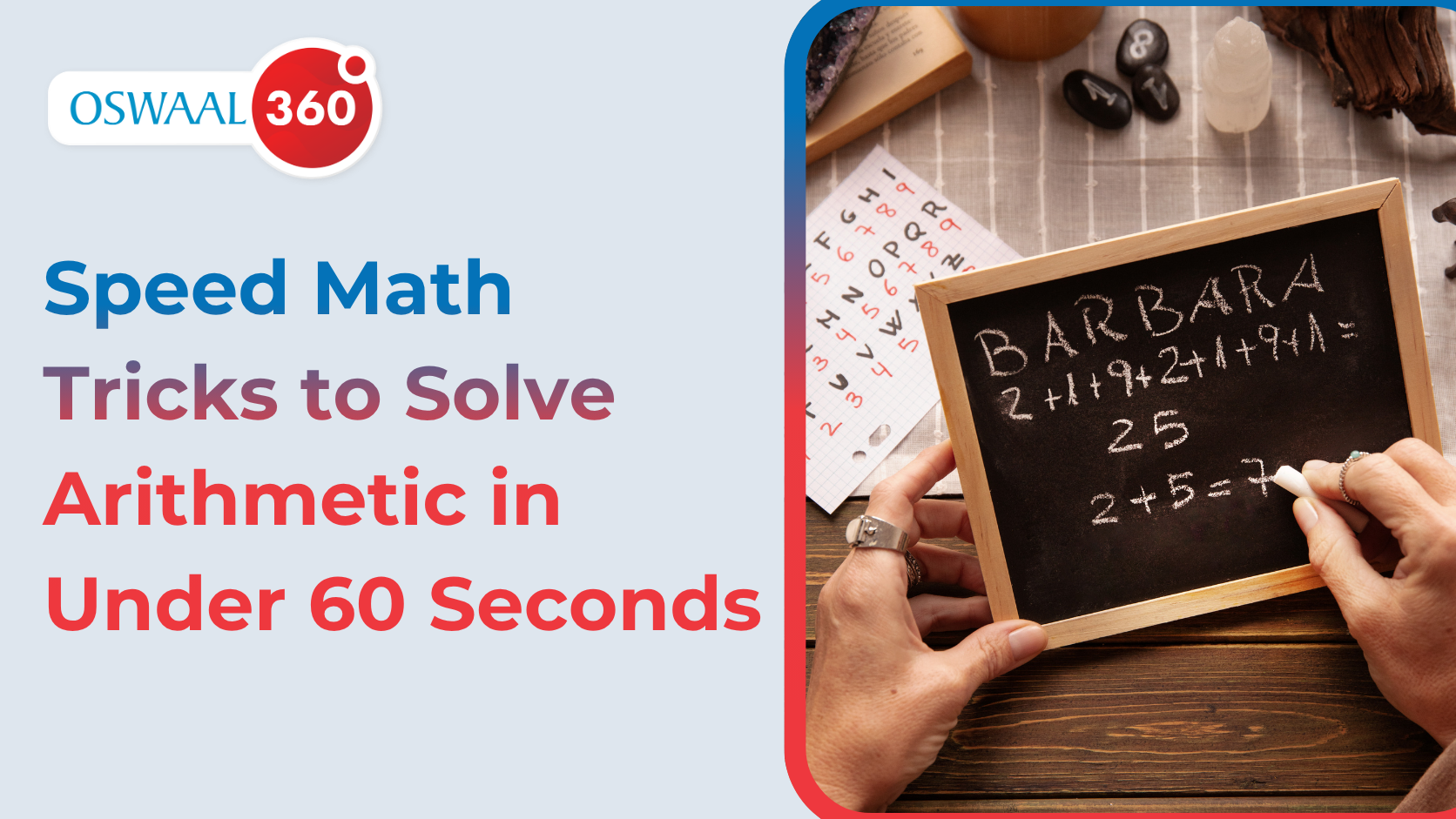
You can solve arithmetic problems in less than 60 seconds, but you have to apply smart speed math tricks, practice, and develop solid fundamentals. Rather than just using the conventional approaches based on a quantitative aptitude textbook or objective arithmetic textbook, learning the correct maths tricks to competitive exams can significantly cut down on the time taken to solve the problem and increase accuracy. Regardless of whether you are using the best book to prepare quantitative aptitude or any aptitude book, learning these tricks will be a significant boost in exams.
Why Speed Math is Important
Speed is a very important aspect in nearly all competitive exams. Arithmetic and quantitative aptitude sections are usually accompanied by time constraints, and it is necessary to find solutions as fast and as precise as possible. Applicants that depend on long calculations usually find it difficult to fill the paper.
Speed math saves time and increases confidence. You have more time to revise answers and do more questions when you can answer questions quicker. This is more so when you are practicing using a quantitative aptitude book or trying mock tests.
Basics You Must Know Before Learning Speed Tricks
It should be noted that before one leaps into tricks, a good foundation must be laid. Shortcuts may cause mistakes without the basic knowledge.
Strong Number Sense
You are supposed to be at ease with numbers, patterns and approximations. It is easier to use shortcuts when you understand the way numbers act. As an illustration, it would be easier to know that 49 is near to 50 or 98 is near to 100.
Tables, Squares, and Cubes
Learning multiplication tables to 20, squares to 30 and simple cubes can be very helpful in increasing speed. A majority of the issues in any aptitude book are simplified when you do not need to compute simple values over and over again.
|
Concept |
Recommended Range |
|---|---|
|
Tables |
Up to 20 |
|
Squares |
Up to 30 |
|
Cubes |
Up to 20 |
Top Speed Math Tricks for Arithmetic
Speed math is about making things easier and not taking unnecessary steps. The following are some of the potent methods:
Fast Addition Tricks
Rather than adding numbers as we are used to, attempt to divide them into simpler components. For example, while adding 468 + 327, you can think of it as 468 + 300 + 27. This saves on mental burdens and accelerates calculations.
Left-to-right addition is another good technique that will allow you to come to the answer quicker without having to write down the steps
Quick Subtraction Techniques
With the complement method, subtraction is easier. To illustrate, you do not need to solve 1000 -487, but can reason how many you have to add to 487 to get 1000.
Another trick is rounding off numbers. For example, 502 – 298 can be calculated as 502 – 300 + 2, which is much faster.
Multiplication Shortcuts
The biggest time-saving tricks are used in multiplication.
The most common one is multiplying by 11. For example:
-
52 × 11 = 5 (5+2) 2 = 572
Near-base multiplication is another technique that can be helpful. For example:
-
98 × 97 can be solved by considering both numbers close to 100, reducing the complexity.
These methods are usually described in a good objective arithmetic book and are necessary to learn maths tricks in competitive exams.
Division Speed Tricks
Approximation can be used to simplify division. The answer is not solved, but estimated and improved. This is effective in multiple choice questions.
Calculation time is also minimized by breaking numbers into smaller parts or simplifying fractions.
Example Practice Table
|
Problem |
Trick Used |
Time Taken |
|---|---|---|
|
48 × 11 |
Multiplication shortcut |
<10 sec |
|
1000 – 487 |
Complement method |
<10 sec |
|
98 × 97 |
Base method |
<15 sec |
Speed Tricks for Percentage, Ratio & Average
Shortcuts make the arithmetic topics such as percentages, ratios and averages a lot easier.
Percentage Tricks
It is easy to use percentages by transforming them into fractions. For example, 50% is 1/2, 25% is 1/4, and 10% is simply dividing by 10. The 10, 5 and 1 percent rule will enable you to compute nearly any percentage in your head.
Ratio & Proportion Tricks
It is time-saving to simplify ratios and then solve. To illustrate, do not work with large numbers, simplify them. Another fast way of solving proportion problems is by cross multiplication.
Average Shortcuts
Rather than summing up all the numbers, employ the supposed mean procedure. This saves on calculation effort particularly when numbers are near one another.
|
Topic |
Trick |
|---|---|
|
Percentage |
Convert to fraction |
|
Ratio |
Simplify first |
|
Average |
Use assumed mean |
How to Solve Questions in Under 60 Seconds
Quickly solving needs a structured approach. The first step is to read the question and determine what kind of problem. Then, select the right trick rather than employing long procedures. Lastly, check your answer before it is too late.
Time management is also significant. When a question appears too long, then it is better to leave it and come back. This habit can be developed by practicing sets of questions with a book of quantitative aptitude on time.
Common Mistakes to Avoid in Speed Math
Speed math can be helpful, but when used excessively, it can create errors because of over-reliance on tricks without understanding. Most students hurry up with calculations and commit haphazard mistakes.
The other similar problem is neglecting simple concepts. No amount of the best book on quantitative aptitude can assist you when your fundamentals are weak. Speed and accuracy should be balanced.
Lastly, do not attempt new tricks in the exam. Always stick to what you have mastered.
Practice Plan to Improve Speed
Speed is something that must be practiced. It can be a big difference, and it does not take much time: 15-20 minutes a day. Pay attention to both simple and complex questions to gain confidence.
Regular solving of questions with a good aptitude book is also helpful to solidify the concepts and become faster with time.
Weekly Practice Plan
|
Day |
Focus |
|---|---|
|
Monday–Tuesday |
Basics and concepts |
|
Wednesday–Thursday |
Learn new tricks |
|
Friday–Saturday |
Practice questions |
|
Sunday |
Mock test and analysis |
Conclusion
Speed math is an influential ability that can assist you to answer arithmetic problems within less than 60 seconds. With good fundamentals and smart tricks, you can become much faster and more accurate. The most important thing is to practice, practice, practice, whether you are practicing out of a quantitative aptitude book or objective arithmetic book or any aptitude book, you just have to practice and apply maths tricks to competitive exams.
Speed is a thing that comes with practice and confidence. The better you practice, the quicker and more precise you will be. Begin using these methods now and make your problem-solving abilities go to a new level.
FAQs
1. Can speed math improve accuracy?
Yes, at least when done well, speed math will enhance speed and accuracy by cutting down on unnecessary steps.
2. How long does it take to master speed math?
Consecutive training will lead to improvement in a few weeks, but it can take several months to master.
3. Are maths tricks useful for all exams?
Yes, these are very beneficial in competitive tests such as SSC, Banking and other aptitude tests.
4. Should I memorize or understand tricks?
You are supposed to learn the reasoning behind every trick and not memorize it.
5. What is the best way to practice speed math?
Practice on a regular basis with a quantitative aptitude book, take timed tests and assess your errors.
Recent Posts
Best ICSE Class 10 Books for Revision and Mock Test Practice
When it comes to the best books for Class 10 ICSE 2027, Oswaal Books are among the top recommendations, prepared around the latest ICSE syllabus with...

UPSC Mains Revision Checklist for GS Paper 1, 2, 3 & 4
The UPSC Civil Services Mains examination tests the knowledge of the candidates across four General Studies papers—GS Paper 1, GS Paper 2, GS...

How Can We Make Studies Fun for Class 2 Kids?
You sit down to study with your class 2 child; after 10 minutes, they begin to fidget, stare at the wall or ask for a break. Sounds familiar? Kids in...
.png)
How do I choose the best CTET books for Paper 1 (Primary Level)?
“Which is the best CTET book to buy?” Most common question aspirants ask. There are so many books in the market that claim to be the best. It’s...

Olympiad Exams Preparation for Class 5 2026-27: Maths, Science, & English Strategy
In the year 2026-27, children will be required to have a slightly better and more structured approach when they are sitting for the Olympiad exams in...
JEE Main 2027 Mock Test Dates: When to Start and How Many Mock Tests to Attempt?
What if you are scoring 180 in mock tests and only 120 in actual JEE Main? Most of the time, the problem is not your preparation, but your mock test...

Best Subject-wise Books for Indian Air Force Group X & Y Exam Preparation
Getting into the Indian Air Force is a dream for many young students across India. Whether you want to join as a technical trade (Group X) or a...

JEE Main 2027 Daily Timetable: How Many Hours Should You Study?
There is one universal question among all the aspirants of JEE: how many hours do I need to study per day to get selected for JEE Main 2027? There is...

Career Options After 12th PCB: Best Courses and Career Paths for Science Students
PCB stream opens doors to dozens of career options, and the decision you make after 12th determines the next few years of your life. Pick courses...
How to Select the Best Math Worksheet Book for Class 6 CBSE?
Class 6 is a very important milestone in the mathematical journey of a student. Concepts get more detailed, questions require more thought, and just...