


What is the best way to prepare for Class 8 exams?
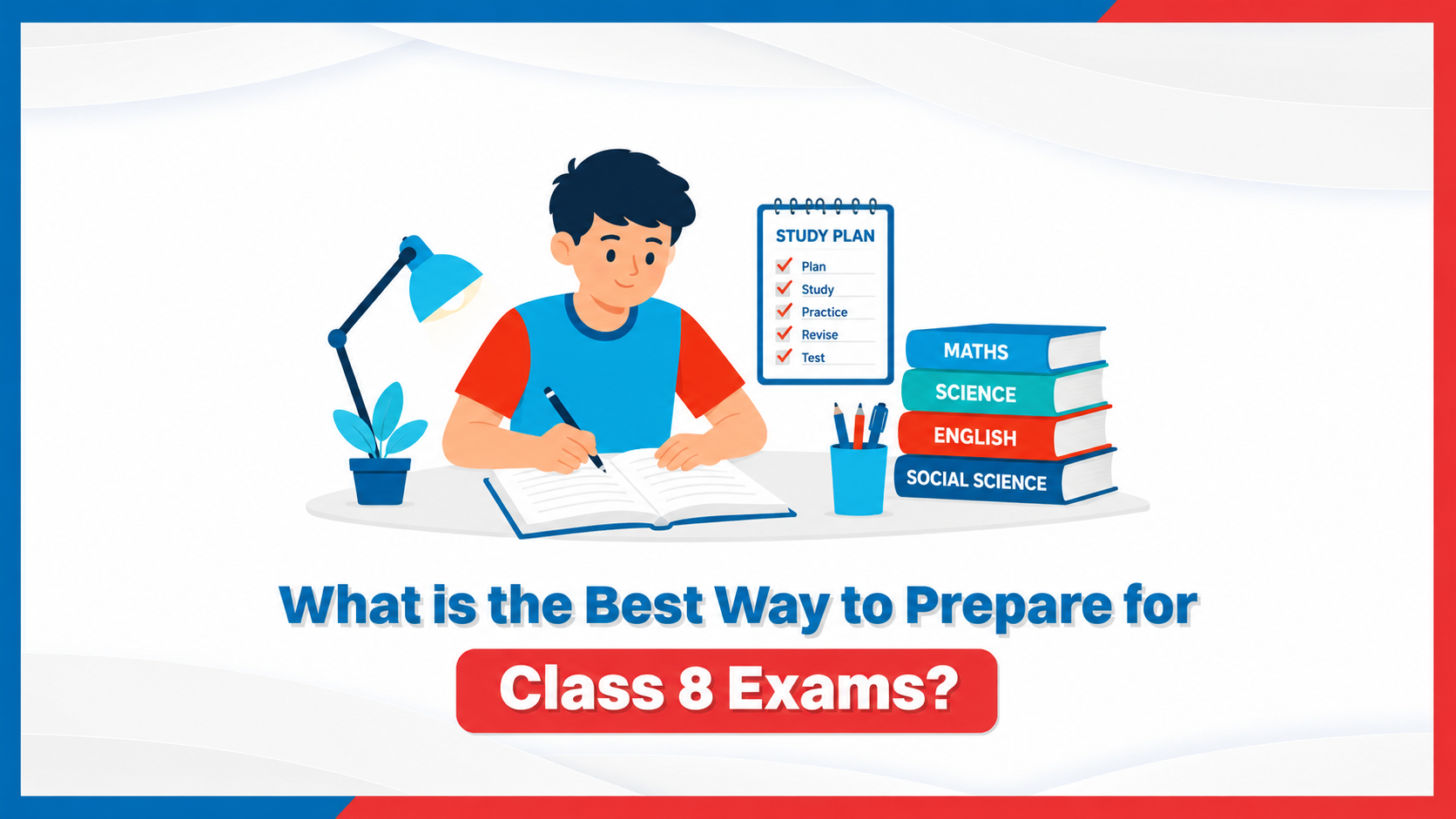
Class 8 is that typical year where students may not have the pressure of board exams, but it is crucial to lay a strong foundation for the upcoming academic years. Weak basics at this stage, be it in Maths or Science, would be a hurdle for the physics derivations and math problems, waiting to be solved in the higher classes. Having an apt knowledge of the CBSE Class 8 exam pattern will make most things easier and push students to have a decent score in the exams.
One approach that works particularly well is combining school NCERT textbooks with additional practice resources. Class 8 question banks, sample papers, and chapter-wise practice exercises help students identify weak areas and build confidence before the exams. Oswaal Class 8 question bank can work wonders by assisting students with extensive practice questions, diverse question formats, chapter-wise practice sheets, and more.
To let your child achieve the perfect 100 score in Class 8 exams, go through this interesting read that will give a glimpse of the CBSE Class 8 exam pattern, study schedule, ways to read NCERT textbooks, and more.
What Is the CBSE Class 8 Exam Pattern?
The CBSE Class 8 exam pattern is largely school-based, meaning individual schools have some flexibility in how they structure assessments. However, the general framework includes:
-
Periodic Tests
-
Half-Yearly Exams (covering the first half of the syllabus)
-
Annual Exams (comprehensive, covering the entire syllabus)
Class 8 students are assessed based on written exams and internal assessment, which includes projects, practicals, notebooks, etc. Performing well in both academic assessments is crucial if you ever searched for your child–how to score 100 per cent in Class 8.
How to Become a Class 8 Topper?
Teachers at CBSE schools often recommend that their students read NCERT books more thoroughly. The NCERT authors embed conceptual depth into every worked example, every margin question, every “Let’s Think” box in the Science textbook. Students are advised to go through these sections more wisely and consistently.
For the CBSE Class 8 Maths book, the NCERT textbook covers important chapters such as linear equations, mensuration, factorisation, data handling, and more. Each chapter builds on the previous one, which is why students who are confused in “algebra” often get stuck with rational numbers.
Subsequently, the CBSE Class 8 Science book includes a wide variety of chapters related to crop production, microorganisms, friction, sound, light, the human endocrine system, and more. Each chapter demands a clear understanding of the concepts rather than just rote memorisation.
The best way to use your NCERT textbooks is to read section-by-section, helping the children to make short notes, revising them well, and writing down what is being learnt.
The Subjects That Most Students Get Wrong: Maths & Science
These two subjects are almost on every student’s list, where they feel stuck and not able to score better. For CBSE Class 8 Maths specifically, they aren’t able to score well because they miss out on including all the possible steps in the exam. Subject teachers reward marks for method, not just the result. This means a correct answer with skipped steps earns partial marks, while a wrong answer with correct working can still earn marks. To score well in this subject, students can take the help of the Oswaal CBSE books Class 8 collection that helps them prepare well for the important chapters such as mensuration, algebraic expressions, linear equations in one variable and more.
For CBSE Class 8 Science, students need to adopt a subject-specific approach for Physics, Chemistry, & Biology. Here, most of the marks are dropped in diagrams, as the students don’t prepare them well. A correctly drawn and labelled diagram of the human ear, an electric circuit, a cell, or the layers of soil can earn 2-3 marks in under two minutes during an exam. Students who never practice drawing them are quite literally giving away free marks. Oswaal question bank Class 8 CBSE would be best for students to learn how to draw, label, and present diagrams accurately. Also, they can practice diverse formats of questions such as MCQs, short-answer, and application questions.
How Oswaal CBSE Class 8 Question Bank Proves to be the Best?
Reading the NCERT textbook and making notes builds knowledge. But the exam doesn’t just test knowledge; it tests the student’s ability to work well under pressure. That gap between learning the concepts and applying them within the strict exam conditions can be bridged by the Oswaal Class 8 Question Bank. It earns a nationwide reputation among CBSE students and teachers by expanding on the following premium features.
Diverse question formats such as MCQs, Very Short Answer (VSA), Short Answer (SA), and Long Answer (LA) questions are covered.
Chapter-wise practice sheets are included to help students practice exam-oriented exercises, offering thorough coverage of every topic.
As students often struggle with diagrams, our subject experts have added diagram-based questions to strengthen visual learning and improve answer presentation skills.
With the shift in the CBSE curriculum, competency-based questions draw more attention as compared to traditional rote-learning questions. In our CBSE Class 8 question banks, we have added case-study & application-based questions to sharpen analytical thinking and problem-solving abilities.
CBSE Class 8 Weekly Study Schedule
To score well in Class 8, parents can motivate their children to stay focused and consistently follow the shared weekly study routine.
Monday / Wednesday / Friday — Maths Focus
-
30 minutes: Solve NCERT exercises for the current chapter
-
30 minutes: Practice additional questions from your question bank
-
10 minutes: Review one previous chapter to prevent forgetting
Tuesday / Thursday — Science Focus
-
30 minutes: Read the NCERT Science chapter actively
-
20 minutes: Draw and label all diagrams from the chapter
-
20 minutes: Attempt chapter-wise MCQs and short-answer questions
Saturday — Weekly Test Day
-
Pick one chapter from any subject
-
Attempt a timed chapter test from your question bank
-
Review every wrong answer — don't just note the correct answer, understand why you were wrong
Sunday — Light Revision
-
Review notes from the week
-
Read ahead to preview next week's chapters
-
Rest. Sleep matters. A brain that gets 8 hours of sleep consolidates memory twice as effectively as one that doesn't.
This isn't a heavy schedule. It's about 1.5 to 2 hours on school days. Consistency over intensity, every time.
Gentle Note For Parents
Children are yet to bloom, having immense potential to explore and make their name. More than studying, what they need is your time, emotional support, and a perfect study plan to be followed throughout the learning journey. A child who understands concepts, enjoys learning, and develops discipline today is far more likely to excel in the future than one who studies only for marks. Oswaal CBSE Class 8 question banks are best for comprehensive practice, exam-oriented questions, competency-based exercises, and structured revision, which they rely on.
You are their constant whom they always lean into, so be their best friend where they always feel safe & heard!
FAQs
1. How many reference books should a Class 8 student use?
Honestly, fewer than most students buy. The ideal toolkit is: NCERT textbook (primary), CBSE Class 8 notes, and one comprehensive question bank. The Oswaal Class 8 Question Bank covers theory, practice, NCERT exemplars, and HOTS in a single volume, meaning most students don't need anything else alongside it.
2. What is the difference between an Oswaal workbook and a question bank for Class 8?
A workbook typically walks you through solved examples first, then gives practice problems; it's better for building procedural skills. A question bank for Class 8 focuses on varied exam-format practice, including previous-year school paper questions, MCQs, and application questions.
3. My child understands the chapter but loses marks in exams. Why?
This is one of the most common issues in CBSE Class 8, and it almost always comes down to one of three things: not practising under timed conditions, writing only final answers without steps (in Maths), or not having seen the variety of question types that appear in exams. Consistent question bank practice solves all three.
4. When should we start using a question bank — beginning of year or before exams?
The beginning of the year, chapter by chapter. Students who use a question bank as a post-reading practice tool throughout the year don't need to cram before exams. Students who open it for the first time two weeks before finals are simply not using it the way it was designed to be used.
5. Are Oswaal books for Class 8 suitable for average students?
Yes, the Oswaal Class 8 Question Bank is structured to work for every level. Questions begin with direct recall and comprehension, progress to application, and then move to HOTS. An average student can work through the first two levels and build genuine confidence, while stronger students can challenge themselves with HOTS and NCERT Exemplar questions.
Check Out Other CBSE Books:
Recent Posts
Best ICSE Class 10 Books for Revision and Mock Test Practice
When it comes to the best books for Class 10 ICSE 2027, Oswaal Books are among the top recommendations, prepared around the latest ICSE syllabus with...

UPSC Mains Revision Checklist for GS Paper 1, 2, 3 & 4
The UPSC Civil Services Mains examination tests the knowledge of the candidates across four General Studies papers—GS Paper 1, GS Paper 2, GS...

How Can We Make Studies Fun for Class 2 Kids?
You sit down to study with your class 2 child; after 10 minutes, they begin to fidget, stare at the wall or ask for a break. Sounds familiar? Kids in...
.png)
How do I choose the best CTET books for Paper 1 (Primary Level)?
“Which is the best CTET book to buy?” Most common question aspirants ask. There are so many books in the market that claim to be the best. It’s...

Olympiad Exams Preparation for Class 5 2026-27: Maths, Science, & English Strategy
In the year 2026-27, children will be required to have a slightly better and more structured approach when they are sitting for the Olympiad exams in...
JEE Main 2027 Mock Test Dates: When to Start and How Many Mock Tests to Attempt?
What if you are scoring 180 in mock tests and only 120 in actual JEE Main? Most of the time, the problem is not your preparation, but your mock test...

Best Subject-wise Books for Indian Air Force Group X & Y Exam Preparation
Getting into the Indian Air Force is a dream for many young students across India. Whether you want to join as a technical trade (Group X) or a...
JEE Main 2027 Daily Timetable: How Many Hours Should You Study?
There is one universal question among all the aspirants of JEE: how many hours do I need to study per day to get selected for JEE Main 2027? There is...

Career Options After 12th PCB: Best Courses and Career Paths for Science Students
PCB stream opens doors to dozens of career options, and the decision you make after 12th determines the next few years of your life. Pick courses...
How to Select the Best Math Worksheet Book for Class 6 CBSE?
Class 6 is a very important milestone in the mathematical journey of a student. Concepts get more detailed, questions require more thought, and just...