


What Is the IGCSE Exam 2026? Everything Parents and Students Must Know
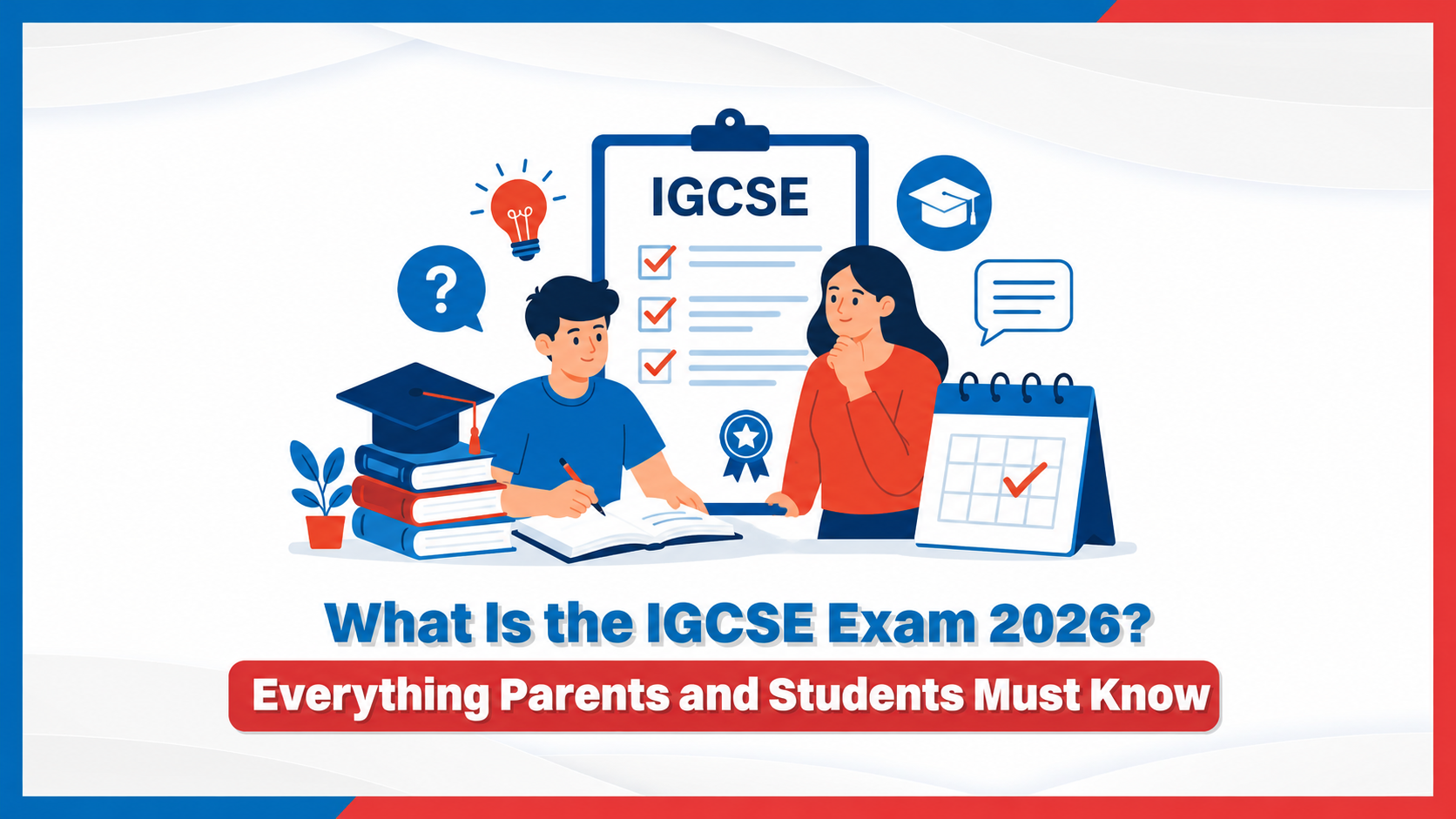
You might have heard the term IGCSE, whether you are a student in Grade 9 or Grade 10, or whether you are a parent considering the best exam for your child. What is it, though?
IGCSE is an acronym for International General Certificate of Secondary Education. It's an internationally recognised qualification for pupils aged 14 to 16. The IGCSE exam 2026 is the next round of exams that students globally will sit.
This exam is managed by Cambridge Assessment International Education (CAIE), which is a part of the University of Cambridge. IGCSE exams are held twice a year in May/June and October/November. The primary session for most students is May/June 2026.
The IGCSE is not a normal school examination. It is recognised by universities, colleges and employers in over 160 countries. If your child is studying in an international school, then it is likely that they are already doing the IGCSE course.
What Is the IGCSE Curriculum?
The IGCSE curriculum is a structured course of study and learning outcomes that enable students to think clearly, write effectively and solve problems. This is unlike local board exams in many countries, which emphasize memorization.
The curriculum is divided into different subject groups. Students are required to learn a combination of languages, sciences, mathematics and humanities. This ensures that all children receive a balanced education.
The IGCSE syllabus for each subject specifies exactly what topics students will be expected to study, the type of questions in the exam, and how the exam will be marked. There are IGCSE syllabuses for each subject: students can download these free of charge from the Cambridge website.
The great advantage of the IGCSE is that it is the same everywhere. The syllabus and standard of the exam is same for students studying in India, the United Kingdom, Singapore or Dubai.
IGCSE Subjects — What Can Students Choose?
IGCSE subjects are divided into five subject areas. Students must select subjects from various groups to ensure that a balanced choice of subjects is studied.
Here are some simple examples of the five subject groups:
|
Group |
Subject Area |
Examples |
|
Group 1 |
Languages |
English as a First Language, Hindi, French, Arabic |
|
Group 2 |
Humanities & Social Sciences |
History, Geography, Economics, Business Studies |
|
Group 3 |
Sciences |
Physics, Chemistry, Biology, Environmental Management |
|
Group 4 |
Mathematics |
Mathematics, Additional Mathematics |
|
Group 5 |
Creative & Vocational |
Art & Design, Computer Science, Physical Education |
The majority of students select 5 to 10 IGCRE subjects. Typically, schools will recommend what subjects to choose according to students' interests and future career plans. In higher classes, students who wish to study science generally opt for the combination of Physics, Chemistry, Biology, and Mathematics.
IGCSE Board Pattern — How Is the Exam Structured?
Students need to have a good knowledge of the IGCSE board pattern. The IGCSE is based on components, rather than a single paper like some exams. This means that each subject will consist of two or more papers and some subjects will also include coursework or practical tests.
The following is typical of the majority of IGCSE subjects:
Paper 1 is typically a multiple choice paper. It assesses fundamental knowledge of the topic. Paper 2 is a written paper consisting of short answer and longer questions. Paper 3 and 4 (Data-based and/or extended writing) are available for some subjects. All science subjects include a practical element, this can be a written Alternative to Practical paper or a lab test.
Many IGCSE subjects have two tiers (Core and Extended). The Core tier is the basic level and the Extended tier is the more advanced level. Students are able to select based on their ability and target grade.
Important Dates for IGCSE Exam 2026
The IGCSE exam 2026 dates are known in advance, which is helpful for students to plan their study schedule correctly. These are the general timelines:
|
Event |
Approximate Timeline |
|
Exam Registration Deadline |
January–February 2026 |
|
May/June 2026 Exams Begin |
Late April 2026 |
|
May/June 2026 Exams End |
Mid-June 2026 |
|
Results Day (June Series) |
August 2026 |
|
October/November Series Begins |
October 2026 |
Please be aware that the dates mentioned may differ by country and school. Please refer to the Cambridge official website or your school for confirmed dates.
IGCSE Grading System — How Are Students Scored?
The IGCSE is a letter-based grading system ranging from A* (highest grade) to G (lowest passing grade). Students who fall below minimum requirements are given a U (Ungraded).
A* and A grades are exceptional and are generally a prerequisite for admission to the best international schools and universities. It is generally accepted that a C or higher is a good pass grade.
The grading covers all papers in a subject (coursework and practical work if relevant). Final grade is based on the total mark from all parts of this subject.
Why Do International Schools Use IGCSE?
International school exams such as the IGCSE are popular because they are designed to prepare students for an international education. The IGCSE curriculum is recognised globally and is taught in many of the top international schools in India, Southeast Asia, the Middle East and Africa.
The IGCSE curriculum builds skills such as critical thinking, research and communication. These are the skills that students require in the university and in their working lives. The IGCSE is a stepping stone to higher education courses such as A Levels and the International Baccalaureate (IB) programme.
Flexibility is another reason why international schools choose to use IGCSE. As both the schools offer the same curriculum, a student who has studied IGCSE in India can seamlessly transition to a school in UAE and proceed from where they had left.
Tips for Students Preparing for IGCSE 2026
Studying for IGCSE exam 2026 can seem like a huge task, but it can be done with the right approach. Here are some easy and practical tips:
Start early. Don't wait till the last few months. Start to review your IGCSE syllabus from mid 2025 and plan a study schedule that allows sufficient time for all subjects.
Use past papers. Past exam papers are available for all IGCSE subjects at Cambridge. Practising with these is one of the best ways to get acquainted with the IGCSE board pattern and the type of questions.
Be familiar with the mark schemes. Mark schemes are included for past papers and indicate how the answers are to be marked. These will help students to know what examiners are looking for.
Concentrate on weaker subjects. A lot of students tend to spend more time on subjects that they enjoy. Pay particular attention to subjects in which marks are lower.
Please care for your health. The brain has a better ability to remember information if it gets some sleep, exercise, and short breaks while studying.
Quick Reference Summary
|
Topic |
Key Information |
|
Full Name |
International General Certificate of Secondary Education |
|
Governing Body |
Cambridge Assessment International Education (CAIE) |
|
Age Group |
14–16 years (Grade 9–10) |
|
Number of Subjects |
Around 70 subjects to choose from |
|
Grading Scale |
A* to G |
|
Exam Sessions |
May/June and October/November |
|
Accepted In |
160+ countries worldwide |
Frequently Asked Questions (FAQ)
Q1. What is the IGCSE exam 2026?
The International General Certificate of Secondary Education (IGCSE) exam 2026 is the next exam session of the Cambridge IGCSE. This exam is taken by students in Grade 9 and 10.
Q2. How many IGCSE subjects do students need to take?
The number of subjects taken by most students is between 5 and 10. Schools advise a minimum of 5 subjects to achieve a balanced qualification.
Q3. Is the IGCSE harder than local board exams?
The IGCSE curriculum is more about understanding and application of concepts than rote learning. Some students think it's different from the local exams, but if they prepare for it, it's very manageable.
Q4. Can students appear in IGCSE without attending an international school?
Yes, there are private candidates who register directly with Cambridge. It's easier and more organized to come across as a registered Cambridge school, however, though.
Q5. When will IGCSE 2026 results be declared?
Results are expected to be released in August 2026 for the May/June 2026 series. This will be announced by Cambridge a little nearer the time.
Recent Posts
Best ICSE Class 10 Books for Revision and Mock Test Practice
When it comes to the best books for Class 10 ICSE 2027, Oswaal Books are among the top recommendations, prepared around the latest ICSE syllabus with...

UPSC Mains Revision Checklist for GS Paper 1, 2, 3 & 4
The UPSC Civil Services Mains examination tests the knowledge of the candidates across four General Studies papers—GS Paper 1, GS Paper 2, GS...

How Can We Make Studies Fun for Class 2 Kids?
You sit down to study with your class 2 child; after 10 minutes, they begin to fidget, stare at the wall or ask for a break. Sounds familiar? Kids in...
.png)
How do I choose the best CTET books for Paper 1 (Primary Level)?
“Which is the best CTET book to buy?” Most common question aspirants ask. There are so many books in the market that claim to be the best. It’s...

Olympiad Exams Preparation for Class 5 2026-27: Maths, Science, & English Strategy
In the year 2026-27, children will be required to have a slightly better and more structured approach when they are sitting for the Olympiad exams in...
JEE Main 2027 Mock Test Dates: When to Start and How Many Mock Tests to Attempt?
What if you are scoring 180 in mock tests and only 120 in actual JEE Main? Most of the time, the problem is not your preparation, but your mock test...

Best Subject-wise Books for Indian Air Force Group X & Y Exam Preparation
Getting into the Indian Air Force is a dream for many young students across India. Whether you want to join as a technical trade (Group X) or a...

JEE Main 2027 Daily Timetable: How Many Hours Should You Study?
There is one universal question among all the aspirants of JEE: how many hours do I need to study per day to get selected for JEE Main 2027? There is...

Career Options After 12th PCB: Best Courses and Career Paths for Science Students
PCB stream opens doors to dozens of career options, and the decision you make after 12th determines the next few years of your life. Pick courses...
How to Select the Best Math Worksheet Book for Class 6 CBSE?
Class 6 is a very important milestone in the mathematical journey of a student. Concepts get more detailed, questions require more thought, and just...