


AFCAT 2026 AFSB Interview: What to Expect After Clearing Written Exam
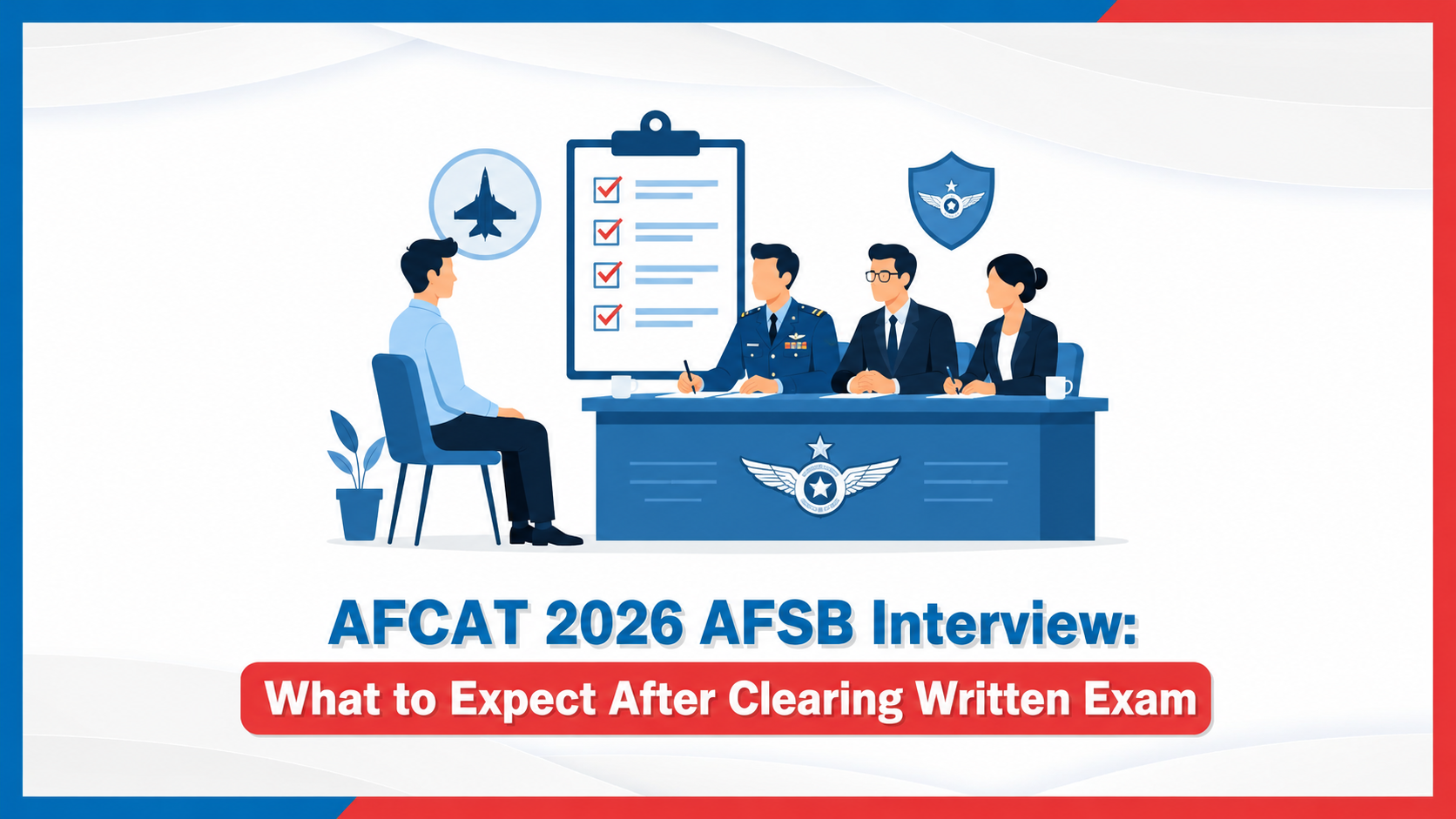
Not everyone who dreams of the sky gets to fly it. The aspiration of wearing those wings on the shoulders begins long before the actual selection day arrives. It starts with the pile of AFCAT preparation books placed on the study table, sacrifices made to skip family functions, narrowing down the friend circle and stubborn refusal to give up. It takes months of consistent preparation, unshakable self-belief, solving endless mocks & AFCAT previous year solved papers, just with a single voice within—One day I’ll make it to the Indian Air Force.
Such a determined approach will make you witness your name in the AFCAT result and get ready for the much-awaited 5-days AFSB (Air Force Selection Board). At the allotted AFSB centres, you will be watched for every move, every word, and every reaction. To excel in the interview and showcase your Officer Like Qualities (OLQs), go through this interesting read, which will give you an AFSB experience at your comfort and fill you with utmost positivity.
Must Read - NDA 2026 Medical Rejection: Common Reasons and How to Avoid Them
What Is the AFCAT AFSB Interview 2026?
AFSB stands for Air Force Selection Board, where the personality, intelligence, leadership qualities, and communication skills are tested. Once the candidates clear the AFCAT written examination, their details are forwarded to one of the AFSB centres, typically located in Dehradun, Mysuru, or Varanasi. In one of these AFSC centres, aspirants are called for a 5-day assessment process that comprises psychological, physical, and intellectual evaluation. Throughout the journey, you must keep in mind that officers sitting in the panel are not to reject the candidates; instead, they are looking for Officer Life Qualities that the Indian Air Force expects from its commissioned officers.
What Are OLQs and How Are Candidates Assessed on Them?
Officer Like Qualities, or OLQs, are an integral part of the AFSB evaluation framework. In total, there are 15 OLQs, grouped broadly into 4 clusters:
-
Planning & Organising
-
Social Adaptability
-
Effective Intelligence
-
Dynamic Qualities
Looking at them, it is quite clear that the officers on the board are not looking for the loudest person in the room; instead, they are looking for those who can take initiative, lead group tasks outdoors, and be a perfect crisis manager.
5-Day AFCAT AFSB Process
You are burning oil, preparing hard for this very day. With pressed formals, polished shoes, and confidence, you'll enter the AFSB centre to enjoy the grind of the 5-day AFCAT AFSB process.
Day 1—Screening Stage
Throughout the AFSB process, this is the filtering stage, where numbers are reduced sharply. After submitting the documents, aspirants are asked to take a test that basically comprises verbal and non-verbal reasoning questions.
These are followed by the Picture Perception and Discussion Test (PPDT), where a hazy image is projected on a screen for about thirty seconds. You need to write down the story around it, with a central character, a situation, and an outcome- a positive one. After this, you will sit with the group and narrate the story around it, and finally the group must collectively arrive at a single common story through open discussion.
While the group discussion takes place, the assessors will be sitting in front of you and observing everything in the room. Not just how you narrate, but how well you are listening, taking a lead in the group, and reaching a definite positive conclusion, that matters the most.
Those who don’t clear the screening stage will be sent back home on the first day itself, so go on prepared with the best AFCAT FSB preparation books.
Day 2 & Day 3—Psychological Tests
It is the trickiest stage of the entire AFCAT AFSB process, where even the aspirants who spent months with the best preparation books often feel completely blindsided. Let’s have a look at how it is different:
Thematic Appreception Test (TAT)-- A series of images are shown briefly, one at a time. For each image, you are expected to write a short story. Through this activity, you will be assessed on how you think, how you face challenges, and how you resolve the conflict more appropriately.
Word Association Test (WAT)-- Approx 60 words are flashed on the screen one after the other, at a rapid pace. For each word, you need to write down the first sentence, be it positive or negative, that came up first in your mind. Here, speed is intentional, so as not to let you think or fabricate the thoughts accordingly.
Situation Reaction Test (SRT)-- Sixty real-life situations are presented in a booklet. A child is drowning. Your teammate collapses during a mission. A senior officer gives you an order you believe is wrong. You respond to each in a few lines. Here, the officers are testing whether your responses can be practical, humane, decisive, and consistent with someone who can be trusted under pressure.
Self Description Test (SDT)-- You are asked to describe yourself as seen through the eyes of five people: your parents, your friends, your own self, and the person you wish to become. This test reveals self-awareness, emotional intelligence, and whether the image you project matches the person you actually believe you are.
Day 3 & Day 4—Group Testing Officer Tasks and Outdoor Activities
After spending the initial days of the AFCAT AFSB interview with pen & pencil, now you will be taken to the field.
Group Discussion (GD)-- A topic is given randomly, and the group is asked to discuss freely. In this part of the interview process, no one is designated as leader; there is a fixed speaking order and no moderator. The assessors will look for candidates who can place their point confidently, engage with opposing views without dismissing them, and help the group to conclude.
Group Planning Exercise (GPE)-- A crisis situation is given, where candidates are assessed on how intricately they analyse, plan, and present a unified solution. This a test of your ability to think practically under pressure while functioning as part of a team.
Progressive Group Task (PGT) and Half Group Task (HGT)--These are group exercises that need to be completed as a team using limited materials such as wooden planks, ropes, and drums. The tasks are designed to surface natural leadership, cooperation, problem-solving, and composure when things don't turn out the way they are supposed to.
Individual Obstacles–You complete the course of obstacles e entirely on your own. This one is for physical confidence, grit, personal courage, and how you carry yourself when there is no group to lean on.
Command Task—In this, you will be placed under the command of two or three other candidates and given a task to complete. For the first time, you are the leader, where assessors will look at how you lead the team, brief the divisions, adapt when the plan does not work, and treat the people under your command.
Lecturette—It is an extempore, where a card with four topics is given, and you are asked to choose one. You then speak on that topic for three minutes, uninterrupted, in front of the group and assessors. This tests your ability to organise thoughts rapidly, communicate with confidence, and hold a room’s attention without a script.
Day 4 — Personal Interview
The personal interview with a Wing Commander or senior Air Force officer typically takes place on Day 4, after the outdoor tasks are complete. This is the most structured part of the AFSB process and also, for many candidates, the most memorable.
Expect questions about your background and family, your reasons for wanting to join the Air Force, your academic journey, your hobbies and interests, and your awareness of national and international affairs, particularly anything related to India's defence, recent Air Force developments, and geopolitical matters. The interview can last anywhere from thirty minutes to well over an hour, depending entirely on how the conversation unfolds.
Day 4 (Flying Branch Candidates Only) — CPSS (Computerised Pilot Selection System)
Earlier, CPSS was known as the Pilot Aptitude Battery Test, or PABT. It takes place immediately after the personal interview. Candidates who have opted for the Flying Branch are required to appear for the Computerized Pilot Selection System, or CPSS. It is a once-in-a-lifetime opportunity, of you do not clear it in this attempt, you cannot appear for it again, regardless of how many attempts AFCAT in the future.
Instrument Battery Test — This assesses your ability to read and interpret cockpit-style instruments accurately and quickly.
Sensory Motor Apparatus Test (SMAT) — This measures your hand-eye and foot-eye coordination through a series of tasks that require you to respond to moving stimuli with precise physical movements.
Control Velocity Test (CVT) — This assesses how smoothly and accurately you can control movement, mimicking the kind of continuous corrective inputs a pilot makes to maintain aircraft stability.
Day 5 — The Conference: Judgement Day
Day five is the last day of the AFSB process. The day begins with a closing address from the assessors, a final formal interaction before the Board convenes. Then the conference begins. This is a meeting of all three assessors, the Interviewing Officer, the Psychologist, and the Group Testing Officer, who collectively review every observation made across the five days and arrive at a final recommendation for each candidate. For those who are recommended, the next step is a medical examination at an Air Force Medical Centre. Final selection into the Indian Air Force is subject to clearing the medical fitness criteria.
Concluding Thoughts
Clearing the AFCAT written exam is a dream come true, where all your hard work, sacrifices, and sleepless nights finally pay off. After this stage, candidates are required to sit for the AFSB interview, where they will be assessed for the Officer Like Qualities (OLQs). Within this process of 5 days, the officers present at the AFSB centre will look for the candidates who are the right combination of intelligence and physical alertness. Those who yearn to be an officer in the Indian Air Force are expected to prepare mind, body, awareness around the world, and above all, honesty with oneself. Complementing this with Oswaal’s AFCAT preparation books and previous-year solved papers will give them the conceptual foundation and analytical sharpness that the panel look for in its commissioned officers.
Have faith in yourself, give your absolute best, and look for the results that you actually deserve!
Frequently Asked Questions
Q1. How long after the AFCAT written result is the AFSB interview scheduled?
AFSB calls are typically issued within four to six weeks of the written result declaration. Candidates receive their reporting date and centre details by post and email.
Q2. How many days does the AFSB interview process last?
The AFSB process spans five days, covering screening tests, psychological assessments, group and outdoor tasks, and a personal interview.
Q3. Can I choose my AFSB centre?
No. The AFSB centre is allotted by the Air Force based on your region and availability. You cannot request a specific centre.
Q4. What should I carry to the AFSB centre?
You are required to carry original documents including your AFCAT admit card, identity proof, educational certificates, and passport-size photographs.
Q5. Is there a medical examination at AFSB?
Yes. Candidates who are recommended by AFSB are referred for a medical examination at an Air Force Medical Centre.
Q6. Which books are best for AFCAT written exam preparation?
Oswaal's AFCAT Previous Year Solved Papers are among the most widely recommended resources. They provide chapter-wise practice, exam pattern insights, and detailed answer explanations that help build both accuracy and speed.
Recent Posts
Best ICSE Class 10 Books for Revision and Mock Test Practice
When it comes to the best books for Class 10 ICSE 2027, Oswaal Books are among the top recommendations, prepared around the latest ICSE syllabus with...

UPSC Mains Revision Checklist for GS Paper 1, 2, 3 & 4
The UPSC Civil Services Mains examination tests the knowledge of the candidates across four General Studies papers—GS Paper 1, GS Paper 2, GS...

How Can We Make Studies Fun for Class 2 Kids?
You sit down to study with your class 2 child; after 10 minutes, they begin to fidget, stare at the wall or ask for a break. Sounds familiar? Kids in...
.png)
How do I choose the best CTET books for Paper 1 (Primary Level)?
“Which is the best CTET book to buy?” Most common question aspirants ask. There are so many books in the market that claim to be the best. It’s...

Olympiad Exams Preparation for Class 5 2026-27: Maths, Science, & English Strategy
In the year 2026-27, children will be required to have a slightly better and more structured approach when they are sitting for the Olympiad exams in...
JEE Main 2027 Mock Test Dates: When to Start and How Many Mock Tests to Attempt?
What if you are scoring 180 in mock tests and only 120 in actual JEE Main? Most of the time, the problem is not your preparation, but your mock test...

Best Subject-wise Books for Indian Air Force Group X & Y Exam Preparation
Getting into the Indian Air Force is a dream for many young students across India. Whether you want to join as a technical trade (Group X) or a...
JEE Main 2027 Daily Timetable: How Many Hours Should You Study?
There is one universal question among all the aspirants of JEE: how many hours do I need to study per day to get selected for JEE Main 2027? There is...

Career Options After 12th PCB: Best Courses and Career Paths for Science Students
PCB stream opens doors to dozens of career options, and the decision you make after 12th determines the next few years of your life. Pick courses...

How to Select the Best Math Worksheet Book for Class 6 CBSE?
Class 6 is a very important milestone in the mathematical journey of a student. Concepts get more detailed, questions require more thought, and just...