What Oswaal 360 has in store for you?

600x354

Champion all the trending Typologies of Questions

600x354

Strengthen your concepts with Detailed Solutions

600x354

Regular practice with Mock Tests and Weekly Practice Papers

Learning that empowers you at every step

free resources.png

Abundant Free Resources

Comprehensive Syllabus Coverage Expertly Solved Papers Free Mock Exams Informative Videos, and More
pedagogical.png

Cutting-Edge Pedagogical Tools

Strengthen Your Comprehension with Cognitive Aids Utilize Mind Maps, Mnemonics, and Concept Videos
professionally curated.png

Professionally Curated Content

Aligned with Current Exam Patterns and Marking Schemes Unlock an Unrivaled Learning Advantage

The Oswaal Advantage

600x354

8 Mn      Students

Largest Student network and community
600x354

300K     Teachers

Most recommended resource by over 3 lakh Teachers
600x354

5000      Schools

Footprint across 5000 Schools across 550 Cities
600x354

Rich Editorial Heritage

Most preferred exam preparation resources.
newUntitled.jpg

Oswaal Editorial Board

Trusted by Students and Teachers alike, Oswaal Books is India’s no. 1 Educational Publisher. For more than 35 years, we have been helping students create better careers through our learning and educational resources.

Our content is authored by our Expert Editorial Board- a body formed by accomplished Teachers, Subject Matter Experts and Educationists from all over the country, with 100+ years of combined experience.

RECENT BLOGS

Career Options After 12th PCB: Best Courses and Career Paths for Science Students
PCB stream opens doors to dozens of career options, and the decision you make after 12th determines the next few years of your life. Pick courses after 12th science PCB that match your interests and aptitude, and the years of study ahead seem meaningful. Pick one on pressure or assumption, and the trip gets harder than it has to be. PCB students often think that their only options are MBBS or BDS. The reality is different. The stream prepares you for careers ranging from biotechnology to forensic science to health care administration, in medicine, research, allied health and in emerging areas such as bioinformatics and data analytics.  This guide takes a look at all the options, so you can find a course that matches your strengths, not vice versa. PCB Student Career Options After 12th (Physics, Chemistry, Biology) PCB stream includes biology, chemistry and physics, which provides you with a foundation that goes way beyond clinical medicine. You might study life sciences, health care delivery, lab-based research, or even policy and administration work related to public health. Traditional courses such as MBBS, BDS and nursing continue to be popular because of their well-defined career path and social recognition. But the scope has expanded. Genetic counselling, clinical research and healthcare data analytics were not defined career tracks a generation ago. Today, they provide stable, good-paying jobs for students who prefer to do research or analysis rather than hands-on patient care. Really, it comes down to what kind of work environment you want: a clinical, hands-on environment, a lab bench, or a desk with data and reports. Best Courses After 12th PCB to Pursue All these courses can lead to a different career, and the right option depends on your interests, exam scores and long-term goals. MBBS: The normal way to become a doctor. It is necessary to qualify NEET and spend five and a half years studying, which includes a compulsory internship. BDS: 4 year degree in dentistry + 1 year internship, leading to dental practice or specialisation. BAMS: Bachelor of Ayurvedic Medicine and Surgery, which integrates traditional Indian medicine with modern diagnostic techniques. BHMS: Bachelor of Homoeopathic Medicine and Surgery, a five and a half years course including internship. BUMS: Bachelor of Unani Medicine and Surgery, focusing on Unani medical practices. BPT (Bachelor of Physiotherapy): A four and half years course in science of movement and rehabilitation. B.Sc Nursing: A four year degree course to prepare students for clinical nursing roles in hospitals and community health. B.Pharm: A four-year pharmacy degree covering drug formulation, pharmacology and regulatory affairs. Pharm D: A six-year clinical doctoral pharmacy program, excellent for students interested in hospital pharmacy. B.Sc Biotechnology: 3-year course in genetic engineering, molecular biology and lab skills. B.Sc Microbiology: Study of microorganisms, useful for research and diagnostic lab jobs. B.Sc Genetics: Covers heredity and gene function. This is often a stepping stone to genetic counselling or research. B.Sc Biochemistry: Study of chemical processes in living organisms, very useful for pharma and research jobs. B.Sc Forensic Science: A blend of biology and chemistry for crime scene analysis and forensic laboratory work. B.Sc Psychology: Focuses on human behaviour and mental processes, leading to careers in counselling or clinical psychology. B.Sc Nutrition and Dietetics: Food science and dietary planning are needed in hospitals and wellness sectors. B.Sc Agriculture: Involves crop science, soil health and agricultural technology. Veterinary Science (BVSc): A five year course for those who are interested in the health and treatment of animals. Bachelor of Occupational Therapy (BOT): A 4.5-year program to train students to help patients recover daily living skills after injury or illness. Medical Career Options After 12th PCB  Several PCB courses provide direct entry to recognised medical professions: Doctor: Diagnoses and treats illness, and requires an MBBS and additional specialisation for most roles. Dentist: Deals with oral health issues, has a BDS degree. Physiotherapist: Helps patients to regain movement and function after injury or surgery. Nurse: Provides care for patients in hospitals, clinics and community settings. Pharmacist: Gives out medication and advises patients on how to take drugs. Occupational Therapist: Helps patients regain independence in their daily activities. Veterinarian: Cares for animals in a clinical or agricultural setting. Non-Medical Career Options for PCB Students  Not every student in PCB wants to work directly with patients. These roles share the same scientific basis in different settings. Biotechnologist: Work in research labs or pharma companies to develop new treatments and products. Microbiologist: Studies or diagnoses bacteria, viruses and other microorganisms in lab setting. Geneticist: Studies how genes work and how traits are inherited, usually in a university or hospital research setting. Forensic Scientist: Investigates evidence in criminal cases. Clinical Research Associate: Managing and observing clinical trials for pharmaceutical companies. Nutritionist: Provides dietary planning and health counselling to individuals or institutions. Psychologist: Diagnose and treat mental health problems using therapy and counselling. Healthcare Administrator: Oversees operations in hospitals, clinics or health systems. Career Options After 12th Science PCB Without NEET  NEET is not the only route forward. Below are the courses that don’t require NEET: B. Pharm B.Sc Biotech B.Sc Microbiology  B.Sc Forensic Science B.Sc. Psychology B.Sc Agriculture  Dietetics and Nutrition Allied Health Sciences These routes are based on your 12th grade marks or entrance tests for particular courses and give you an option to move ahead even if NEET does not work out. Govt Job Options for PCB Students Jobs in government provide job security and clear-cut career growth. PCB Graduates can work in: Govt Hospitals: Jobs for Doctors, Nurses and Allied Health Staff through State and Central Recruitment Exams. Public Health Departments: Positions in disease prevention, health education and policy enforcement. Research organisations: ICMR, CSIR, etc., recruit science graduates for research work. Defence medical services: The Armed Forces Medical Services recruits doctors, nurses and paramedical staff. Healthcare and pharmaceutical sector jobs: Public sector pharmaceutical companies and health regulatory bodies provide stable roles for pharmacy and life sciences graduates. New Career Opportunities for PCB Students Technology and data have created a new set of careers, opening new ground for PCB students: Genetic Counselling: Explains genetic risks and helps people make informed decisions about their health. Bioinformatics: Using computational tools to study genetic and molecular data in biology. Clinical Research: Deals with drug trials and studies. This is a growing field with growing pharma investment. Public Health: Prevention of disease, health promotion and health policy at a population level. Healthcare Data Analytics: Leverages data to enhance hospital operations and patient results. Medical Laboratory Technology: Assists in diagnosis through testing and analysis in the laboratory. Best Career Option After 12th PCB Course: How to Choose? Start with what really interests you. A well-paid but tedious career is hard to maintain for decades. Next, consider the entrance exams. NEET opens doors for medical and dental fields, but many other good courses like biotechnology, psychology, and agriculture have separate entrance exams or some take direct admission based on 12th marks. Also, think about career scope. Certain fields, like nursing and pharmacy, are always in demand nationally. Some are still emerging in India, like genetic counselling, but these have huge potential to grow strongly. Finally, consider the salary potential. Specialist medical careers pay better, but take longer to train. Many allied health and research jobs provide a quicker path to gainful employment. Best Books for PCB Students to Prepare Class 12 CBSE Class 12 Books for All Subjects The entrance exams test for conceptual clarity. A comprehensive preparation resource helps you build it. Oswaal CBSE One for All Class 12 Books consolidate NCERT content, previous years’ questions and practice papers at one place, making revision much more efficient for the exam. Class 12 NCERT Problem Solution Books Most of the PCB entrance exams, including NEET, have NCERT as their base. It is better to have a firm grip of NCERT concepts thoroughly before jumping into reference books. This is true for both board exams and competitive exams. Oswaal NCERT Class 12 problems solutions textbook explains each question of a chapter in detail so that you can identify any gaps in understanding before the day of the exam. Conclusion Most students don’t realise at first how much more flexibility the PCB stream has to offer. Medicine and dentistry are excellent choices for students who want to provide direct patient care, but for those who have other skills, research, allied health and emerging data-driven fields offer equally rewarding opportunities. Which one you choose will depend on your interests, your comfort level with certain entrance exams, and what kind of work environment you want for the next decade. Think about what you like, but also think about practical things and choose a field you can work in with confidence. Frequently Asked Questions Which are the best PCB career options after 12th? The most popular and safe career options for PCB students are medicine, dentistry, nursing, pharmacy, biotechnology, and allied health sciences. Do PCB students get jobs without NEET? Yes. NEET qualification is not required for courses such as B.Pharm, B.Sc Biotechnology, B.Sc Microbiology and B.Sc Psychology. What are Govt job opportunities after 12th PCB? Government hospitals, public health departments, research bodies like the ICMR and defence medical services recruit PCB graduates. What is the best course after 12th PCB for future growth? Biotechnology, bioinformatics and healthcare data analytics are growing strongly as these fields expand with research and technology.
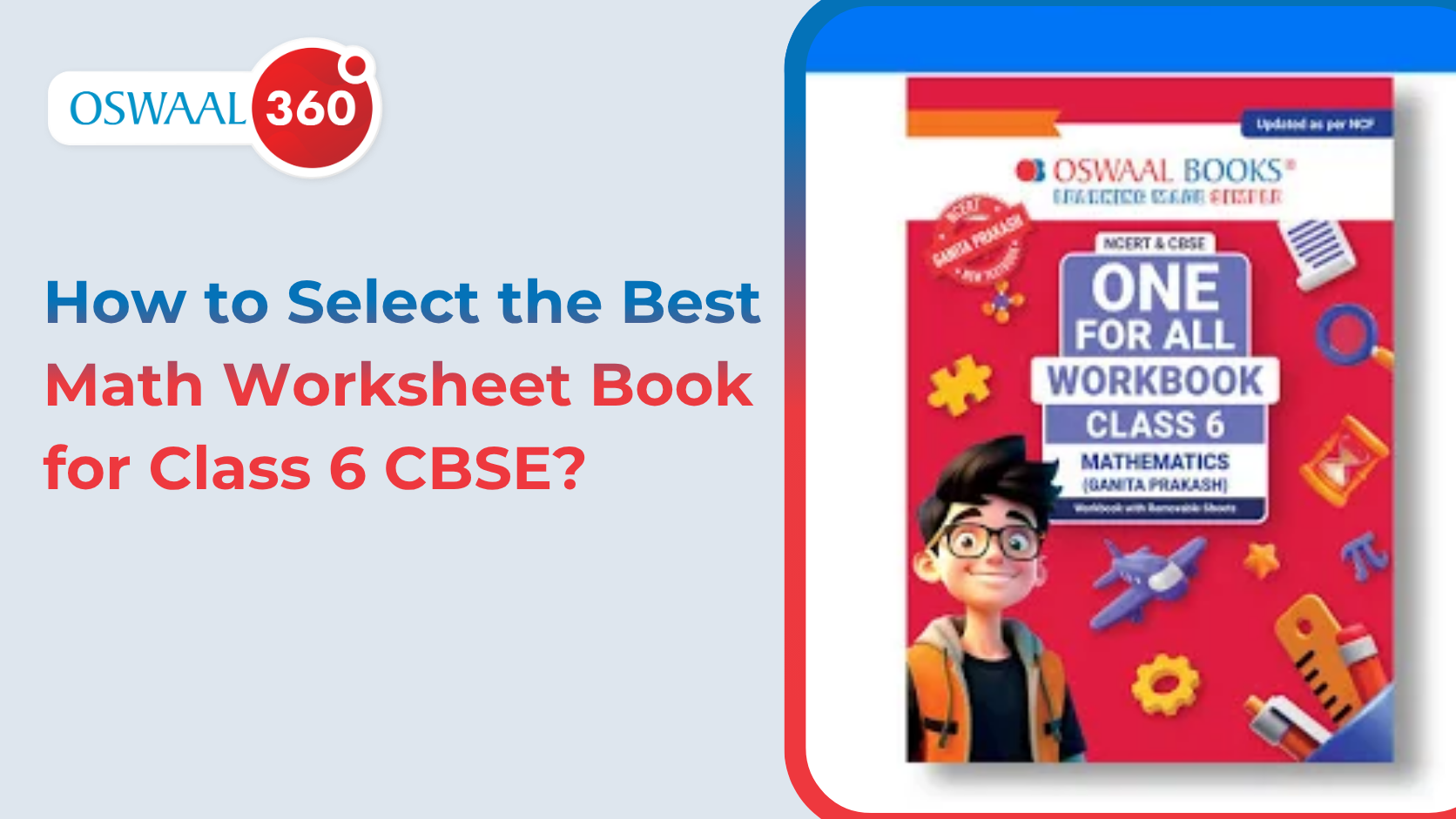
How to Select the Best Math Worksheet Book for Class 6 CBSE?
Class 6 is a very important milestone in the mathematical journey of a student. Concepts get more detailed, questions require more thought, and just reading the chapter isn’t enough anymore. This is where the right worksheet book can really help. Just think, how can you become good at cricket by just watching the games? Or learn to ride a bike by reading a manual? Perhaps not. Mathematics works the same way. The more you solve, the more confident you get. A good worksheet book helps students practise various kinds of questions, apply concepts in new situations and gain the confidence they need for school exams. It bridges the gap between ' I understand the chapter' and ' I can solve any question from the chapter. In this blog, we’ll help you pick the best workbook that promotes consistent learning, effective practice, and better performance without turning the buying process into a guessing game. What Makes a Class 6 CBSE Maths Worksheet Book Good? A worksheet book is only useful if the way of assessment is actually how CBSE does it. This is the difference between a good 6 std maths book CBSE and a mediocre one. Aligned with the recent CBSE syllabus. CBSE updates its syllabus from time to time, and a book based on an old syllabus will waste a student’s time on topics that are no longer asked in the exams.” Chapter-by-chapter worksheets. The chapter-wise worksheets help students to practise one topic at a time instead of switching between topics. Different questions types. It includes MCQs, short answers, long answers and fill in the blanks to help the students prepare for all types of questions asked by the CBSE. Gradual difficulty. The worksheets start with simple questions to advanced questions so that the student gains confidence before attempting the tougher problems. Space for practice and revision by yourself. A workbook that lets you write, redo problems, and revise for exams is real value for more than one read. Things to Know Before Buying a Class 6 Maths Workbook Comprehensive syllabus coverage. Dedicated worksheets for each and every chapter of the current CBSE Class 6 maths syllabus should be available and not just the popular ones. NCERT based practice. Since CBSE exams are more or less based on NCERT, a workbook which follows the same pattern and language helps students to actually use their textbook knowledge. Competency questions. CBSE has adopted a competency-based assessment that tests application and reasoning instead of rote memorisation. A good workbook shows this shift. Higher Order Thinking Skills (HOTS). Students are challenged by these problems to move beyond recall of formulas and into problem solving, just what higher scoring students need to practise. Questions for practical application. Real-life word problems provide students with a reason to learn and not just how to solve a problem on paper. Answer key or worked Solutions. Solutions with step-by-step working enable a student to self-check and understand mistakes without needing a teacher present for every question. Worksheets for assessments and revision. Chapter-end tests and cumulative revision sheets help students to consolidate their learning before the school exams. Why CBSE Syllabus Alignment is Important? The syllabus alignment is not a trivial detail. It affects how a student uses their study time and how well that time is converted into exam scores. Ceases to study irrelevant topics. CBSE may remove or change topics in an old or generic book, and students end up practising content that will not be in any exam. Matches school tests. Schools are strictly following the CBSE syllabus and exam pattern. A syllabus-aligned workbook that mimics the same style and level of difficulty of questions students will face in class tests and finals. Builds a solid NCERT foundation. Since NCERT is the backbone of teaching in CBSE, a NCERT maths workbook for Class 6​ approach reinforces what students already learn in school, instead of introducing conflicting methods. NCERT vs Worksheet Books – Should You have both? Parents and students often wonder if one CBSE board class 6 maths book​ is enough. The honest answer is NCERT and worksheet books serve different purposes. NCERT TextbookObjective. NCERT introduces concepts, explains methods and gives limited solved and unsolved examples. It sets the base. Worksheet books purpose. Worksheet books build on that foundation and add in repetition. It has more questions for a concept than NCERT, which is exactly what a student needs to go from understanding a method to applying it independently. How they work together. NCERT explains the ‘what’ and the ‘why’ while the worksheet books work on the ‘how much practice’. Together, they cover both learning and reinforcement that cannot be achieved by the study of a single book. Common Mistakes to Avoid When Picking a 6 Class Maths Workbook Purchasing books with outdated syllabus. Always check the year of publication and make sure book is as per the latest syllabus of CBSE. Only hard questions. A book full of hard problems can only frustrate a student, and skip the basic practice to build a strong foundation first. Not looking at solution quality. For students, if they get a question wrong, answers without the correct working steps leave them stuck when they can’t figure out where the mistake happened. Choosing books without a structured practice. Random questions without chapter-wise classification make revision difficult and waste study time. Who Should Buy Class 6 Maths Worksheet Book? Worksheet books are great for many students and situations, not just for those who have difficulty with maths. Students who require daily practice. Regular problem solving keeps the concepts fresh and prevents the last-minute cramming that leads to poor retention. Students are getting ready for school tests. Worksheets that follow the CBSE exam pattern help students get used to the question formats that will be asked in the exams. Students who want to strengthen their basics. Even students who grasp concepts well need a little extra practice to increase their accuracy and speed. Parents seeking guided home practice. Even if parents aren’t subject matter experts, a well-organised workbook can be a handy framework for helping with homework. Why Choose Oswaal Class 6 Maths Worksheet Book? Oswaal Class 6 Maths Worksheet Book covers everything that we have discussed in this blog so far. CBSE latest syllabus is in sync, so students only practise what is relevant to their current syllabus. The worksheets are arranged chapter-wise, so you can focus on one topic at a time. The book has competency based practice questions as per the current exam pattern of CBSE. The detailed NCERT maths workbook Class 6 solutions​ help the students to understand where they went wrong and how to correct it. Through regular use, it reinforces revision and concept building and provides students with a useful resource for daily study and exam preparation. Conclusion Most suitable worksheet for Class 6 is one that matches the latest CBSE syllabus, chapter-wise questions, and includes a variety of questions. A book that meets these criteria promotes real learning, not just more pages to solve. Before you buy, run through this quick checklist: Is the syllabus up to date? Are the worksheets in chapter order? Do you have questions ranging from beginner to advanced? Do you give detailed solutions? Does the book allow for revision, not just first time practice? Forget gimmicks and flashy extras. Focus on clarity of concepts, complete syllabus coverage and regular practice. A workbook that sticks to these fundamentals gives students exactly what they need to face Class 6 maths with confidence, one worksheet at a time. Other Recommended Books Buy CBSE Class 6 Books Buy One For All Question Bank NCERT & CBSE - Class 6 Buy NCERT Textbook Solution + Exemplar for Class 6 Buy CBSE Class 6 Workbook with Practice Worksheets CBSE Class 6 Notes CBSE Class 6 Syllabus CBSE Class 6 Grading System CBSE Class 6 Exam Pattern Explore Our CBSE Class 6 Exam Blogs   FAQs (About Class Worksheet) Which is the best maths book for Class 6 CBSE? The best book is the one that is in sync with the current CBSE syllabus, adheres to the NCERT approach, provides chapter-wise worksheets and has detailed NCERT Class 6 maths workbook solutions​. Oswaal’s Class 6 Maths Worksheet Book is good to go for the above requirements and is good for regular practice. How many worksheets should a Class 6 student do per week? Two to three worksheets per week on topics being taught in school will help keep the practice consistent without overwhelming the student. This pace also allows for revision worksheets closer to the exams. Which is the best Class 6 maths workbook? Look for these features: Syllabus alignment, chapter wise presentation, variety of question types, HOTS and competency based questions, problems based on applications of real life and detailed answer keys. Do worksheet books help in CBSE exam preparation? Yes. The worksheet books are based on the CBSE exam pattern and give students a chance to practise the type of questions they will come across in school tests and final exams, thus developing accuracy and speed.
How to Improve Your Exam Scores Using Online Resources
Imagine: You are studying for six hours straight. You close your books feeling exam ready. And freeze the moment you get the question paper. You are not alone. 
How to Improve English for NDA in 30 Days: Practical Plan
English is one of the most scoring yet most underestimated subjects in the National Defence Academy (NDA) examination. Thousands of aspirants focus heavily on Mathematics and General Knowledge while neglecting the English section, only to lose precious marks that could have made the difference between selection and rejection. The good news? With a focused, structured approach, you can significantly improve your English proficiency in just 30 days. This guide covers everything you need, from understanding the exam pattern to building skills that last beyond the exam. Understanding the English Section in NDA The NDA written exam's English section is held by the Union Public Service Commission (UPSC). The English paper is awarded 200 marks and is included in the General Ability Test (GAT). This section involves: Spelling Errors: Recognition of grammatical errors in sentences Sentence Improvement: Finding out the best option to improve a particular sentence Ordering of Words/ Sentences: Arranging of scrambled sentences to make a coherent passage Word Selection: Fill-in-the-blank questions testing your vocabulary Comprehension Passage: Comprehending a passage and answering the given questions Synonyms and Antonyms: Testing your word knowledge Idioms & Phrases: Knowledge about commonly used idioms & phrases in English language All the questions of the English section are of the objective type, implying that not only accuracy but also speed plays an important role here. A negative marking system is also applied in this section. Why English Should Matter More to You For many aspirants studying in a Hindi or regional medium, English poses an intimidating challenge. The fact is, English in the NDA is not conversational fluency; rather, it is knowledge of grammar, reading, and vocabulary. And all of these things can easily be picked up through practice, no matter your medium of study. It is very much possible to score 140+ marks in English in 30 days. These marks can more than make up for any deficit in Mathematics and help ensure that you clear the overall aggregate cut-off. 30-Day Roadmap to Master NDA English Phase 1: Assessment and Building Foundation (Day 1 - 7) Don't start preparation without taking the diagnostic test through the books of the NDA previous year's paper. Know the weak spots of yours; know which topics cost you marks the most. During this phase, do the following things: Revise basics of grammar – tenses, articles, prepositions, subject-verb agreement, active/passive Maintain a small notebook of grammar rules. Write down each rule along with examples in your own words.At least 30 minutes a day – read English newspapers like The Hindu and The Indian Express, focusing on sentence level, not on word level. Start your vocabulary list. Learn 10 words a day with meaning, synonyms, antonyms and their use in sentences. Target: cover all basic topics of grammar and learn 70 words. Phase 2: Topic-wise study (Day 8-18) It is the most hectic phase of your preparation; handle each topic individually: Grammar-based Topics (Spotting errors, Sentence improvement) These questions judge your knowledge of grammar rules. So focus on the following topics: Articles (a/an/the) – when to use, when to avoid Prepositions – especially confusing ones like 'in/at/on' and 'since/for' Conjunctions – correct usage of Modifiers – dangling and misplaced modifier Parallelism in sentence Practise at least 30-40 questions of each type. Always analyse the reason for the wrong answer. You gain more from knowing why your answer was wrong rather than knowing that your answer was right. Vocabulary (synonyms, antonyms, fill in the blanks) Vocabulary can never be stuffed in one night; it needs continuous input. The root-word-based learning method comes in handy, as it is helpful in guessing the meaning of unknown words with the help of Latin and Greek roots like bene = good (beneficial, benevolent) mal = bad (malicious, malfunction) script = write (manuscript, inscription) Flash cards (physical or virtual) work really well for vocabulary. Revise your word list every morning in 10 minutes. Idioms and Phrases There are questions on commonly used idioms in NDA. Have a separate list of at least 100 idioms with meanings and examples in sentences. Divide them thematically (idioms related to time, money, relationships, etc.). Reading Comprehension Practice reading comprehension questions every day. Required skills for solving such questions are as follows: Ability to read fast without losing the comprehension Main idea v/s supporting details Contextual inference Tone of the writer – critical, neutral, appreciative Try to solve the comprehension questions after reading the passage, not while reading it. Ordering of sentences Questions that judge your logic combined with language sense. Watch out for the following points: Introduction sentence (contains topic without pronouns) Cause-and-effect relationship Time sequence – first, then, finally, subsequently Words of contrast and addition – however, moreover, despite Target: complete topic-wise preparation of all six topic areas. Solve 200+ practice questions. Phase 3: Mock Tests and Revision (Days 19–27) Now it is time to bring everything together under exam conditions. Take full-length English section mock tests (timed, 2.5 hours for the full GAT paper) Analyze every mock test thoroughly categorize errors as knowledge gaps vs. careless mistakes Revisit your grammar notes and vocabulary list regularly Refer to quality NDA books for additional practice sets, especially for topics where your accuracy is still below 70% Focus on improving speed: practise reading faster without losing comprehension At this stage, your goal is not to learn new things; it is to consolidate what you already know and eliminate repeated mistakes. Target: Complete 5–6 full mock tests. Achieve consistent accuracy of 75%+ in English. Phase 4: Final Revision and Confidence Building (Days 28–30) The last three days are for light revision, not heavy study. Go through your grammar notes and vocabulary list one final time Solve 20–25 practice questions per topic – just enough to keep your mind sharp Avoid learning new topics at this stage Rest adequately and maintain a calm, focused mindset Common Mistakes to Avoid Ignoring comprehension passages — They carry significant marks and reward consistent readers Memorizing answers without understanding rules — Grammar patterns repeat across questions; understanding > memorizing Skipping error analysis — Every wrong answer is a lesson. Skipping this is the costliest mistake Neglecting vocabulary — A weak vocabulary affects performance in at least 4 out of 6 topic areas Attempting unknown questions blindly — Due to negative marking, leave questions you genuinely cannot attempt Daily Habit Schedule for English Improvement Time Slot Activity Morning (20 min) Revise yesterday's vocabulary list Morning (30 min) Read one newspaper article carefully Afternoon (45 min) Topic-wise practice (grammar or vocabulary) Evening (30 min) One comprehension passage + review Night (15 min) Add 10 new words to vocabulary list Consistency over intensity. Forty-five focused minutes daily beats a four-hour cramming session once a week.   Other Recommended Books | Study Materials Buy NDA Books  Buy NDA Previous Year Question Papers  NDA II Exam Pattern NDA Syllabus  NDA Notes  NDA Admit Card NDA II Age Limit NDA II Eligibility Criteria NDA II Cut Off NDA II Result Explore Our NDA Exam Blogs Conclusion The English paper of the NDA exam becomes one of the high-scoring subjects when prepared properly. You need to prepare yourself according to a well-formulated timetable that includes grammar, vocabulary, reading, practice, revision, and mock tests over the course of 30 days. Consistency is the magic ingredient of success here. Through proper implementation of this practical timetable, you can develop your English abilities, increase your confidence, and take one step towards fulfilling your dream of getting admission into NDA.
NEET 2027 Mock Test Schedule: When to Start and How Many to Attempt
Based on the NTA’s consistent scheduling pattern, the NEET 2027 is likely to take place on May 2, 2027. Nonetheless, aspiring candidates may have to wait until February 2027 for the confirmed date and official notification.  With the application clock already ticking, aspirants need a clear plan — not just for the syllabus, but for exam-day speed and stamina. That's where NEET mock test papers come in. Comprising 180 questions to be attempted in the span of 180 minutes, NEET candidates need to develop their ability to act quickly and exhibit precision at the same time- something revision cannot provide them with. The advised methodology: cover at least 70-80% of the syllabus first, and then start practicing the NEET mock tests several months before the exam. A structured schedule of 40 to 50 full-length NEET mock test papers, attempted phase-wise, is what separates aspirants who freeze under exam pressure from those who walk in ready for a seat at a top government medical college.
UGC NET Paper 1 Data Interpretation: How to Solve in Under 3 Minutes
The UGC NET Paper 1 Data Interpretation questions can be solved in less than 3 minutes for a set of related questions by first reading the title or units of the table/charts, then solving direct data extraction questions on the spot and finally taking approximation rather than exact calculation for percentage or ratio based questions. It is one of the easiest sections to get all the marks from as one does not fear it, but uses the right approach to get the 10 marks as there is no negative marking. In this guide you will get to know about what is covered in Data Interpretation, its importance in UGC NET paper 1 and some handy UGC NET tricks to solve it quickly. What is Data Interpretation in UGC NET Paper 1? Data Interpretation, commonly referred to as DI, is a part of the exam that assesses your ability to read and interpret data presented in tables, charts, and graphs, and then answer questions based on the information. Fearing the questions, many aspirants, particularly from humanities or arts backgrounds, think it is a daunting task but the fact is that these questions are not testing any advanced mathematics but basic arithmetic skills that one learned in the school.  Data Interpretation is one of the easiest units to get 10 marks in UGC NET Paper 1 as there is no negative marking. That's why it's always a plus to have a quick and reliable approach to solving DI questions, as more and more aspirants choose to avoid this section or are intimidated by it. UGC NET Paper 1 Structure and Where DI Fits In It is helpful to have a complete picture of Paper 1 before you get started on Data Interpretation, so that you can gauge how much time you will have. Paper 1 Detail Information Total Units 10 Total Questions 50 (5 questions per unit) Marks per Question 2 marks Total Marks 100 Total Duration 1 hour (60 minutes) Average Time per Question Around 72 seconds Negative Marking None Paper 1 is 60 minutes long and has 100 marks – this is about 72 seconds per question – this may seem tight, but with practice you can get through the paper within this time. Data Interpretation questions are typically presented as a series of questions from a single data source (table or chart) and this is where a 3-minute strategy for the whole set works to your advantage — you can read the data once for all of the questions, rather than once for each question. Generally, UGC NET Paper 1 sets 2 marks each question per unit in total 50 questions and 100 marks for 10 units of which Data Interpretation is one. Types of Data Interpretation Questions You'll See Understanding the common formats will enable you to go into practice smartly rather than randomly. DI Question Type What It Involves Table-based questions Reading numbers directly from rows and columns Bar chart questions Comparing values shown as bars Pie chart questions Understanding percentage share of a whole Line graph questions Identifying trends over time Percentage/Ratio calculations Multi-step reasoning using the given data In UGC NET Paper 1 Data Interpretation section is mainly based on Table and Pie Chart topics and after studying this section for 15-20 days, any student can easily learn the formulas and concepts to get a good score. It is also important to note that the pattern of questions has changed over the years: Papers from 2015-2018 had one set of data and 5-6 questions, but from 2019, NTA has introduced two sets of data with 2-3 questions each. The 3-Minute Method — Step-by-Step Strategy Consider the following method to solve a Data Interpretation question set quickly and repetitively: Scan first, don't calculate (20-30 seconds): Scan the title, headings, and units in the table or chart before reading the questions. This indicates the meaning of the data. Sort questions by difficulty (10 seconds): Scan through all the questions in the set and roughly estimate which are data-reading and which are calculation. Answer direct questions first (30-45 seconds each): If the question is simply "which city had the highest value", you can respond to this almost instantaneously by scanning the data. Use approximation for calculations (45-60 seconds each): When the answer choice options are far apart in percentage or ratio problems, approximate numbers rather than calculate exact decimals. Attempt every question: There is no negative marking, so attempt all the questions and even if you guess at a DI question, you have a chance at getting it right. A time-saver is to solve the questions in the order they are given rather than in the order they are numbered, because questions that are direct reading can be solved pretty much as fast as they are read. UGC NET Tricks to Save Time on Calculations The key to speed in Data Interpretation is smart shortcuts, and not quick math. Master percentage, ratio, and average basics: Most of the Data Interpretation questions are based on percentage calculation and average calculation and if you have a good grip over the basic concepts of percentage and average calculation then you can solve almost all the questions in the Data Interpretation section quickly. Practice two-digit addition and multiplication: Speed of solving basic 2 digit addition and multiplication will directly help in solving Data Interpretation problems. Avoid unnecessary exact calculations: Many questions require you to compare or estimate fractions and percentages, and it is often more time consuming to calculate the exact decimal value than necessary; approximate and compare to the provided answers. Identify the answer range first: If the options are very different from each other, it may be possible to make a rough estimate in order to select the correct answer. Summary UGC NET Paper 1 Data Interpretation is a scoring section with a non-negative marking system and a total of 10 marks, hence it is one of the best sections to focus on irrespective of the academic background. Questions assess basic arithmetic skills using tables, bar charts, pie charts and line graphs; the secret to a full question set in less than 3 minutes is to first scan the data in the question, then answer direct-reading questions immediately, and approximate the calculations of the questions that require them. Aspirants can consistently get full or near full marks in this section by following a structured practice plan of 3-4 weeks which concentrates on the basics of percentage and ratio and previous years' UGC NET Data Interpretation questions. Additionally, having a structured study plan that incorporates topic-wise practice sets from Oswaal Books' UGC NET Paper 1 guides can help maintain a consistent and confident preparation schedule. Related UGC NET Preparation Books & Study Materials Buy UGC NET Books Buy UGC NET Previous Year Question Papers Buy UGC NET Mock Test Papers UGC NET Age Limit UGC NET Notes UGC NET Exam Pattern UGC NET Eligibility Criteria UGC NET Result UGC NET Syllabus UGC NET Exam Date Explore Our UGC NET Exam Blogs Frequently Asked Questions (FAQs) 1. How many marks does Data Interpretation carry in UGC NET Paper 1?Data Interpretation generally carries around 10 marks, coming from about 5 questions worth 2 marks each, though this can vary slightly by exam cycle. 2. Is there negative marking for Data Interpretation questions in UGC NET?No, UGC NET Paper 1 has no negative marking, so every Data Interpretation question should be attempted. 3. Do I need advanced math knowledge to solve UGC NET Data Interpretation questions?No, most questions test basic school-level arithmetic like percentages, ratios, and averages rather than advanced mathematics. 4. What are the most common chart types asked in UGC NET Data Interpretation?Table-based and pie chart questions are the most frequently seen formats, along with bar charts and line graphs. 5. How can I improve my speed for Data Interpretation questions?Practicing basic calculations daily, using approximation instead of exact answers, and solving previous years' question sets under timed conditions are the most effective ways to improve speed. 6. How many days does it usually take to master UGC NET Data Interpretation?With focused daily practice, most aspirants can build strong command over this section in about 15 to 20 days.
Do Olympiad Certificates Help in School Admissions?
Yes, Olympiad certificates can be helpful for admission in schools. They are not a ticket to a seat, but they add strength, dedication, and talent to a student's profile. Many schools prefer to see that children have undertaken something outside the scope of their regular schoolwork and Olympiad certificates would reveal that. In this blog, we will make it easy for you to understand how these certificates can assist you and what else you should find out about academic competitions.

TESTIMONIALS